


Page 384 - Physical chemistry understanding our chemical world
P. 384
KINETIC DEFINITIONS   351

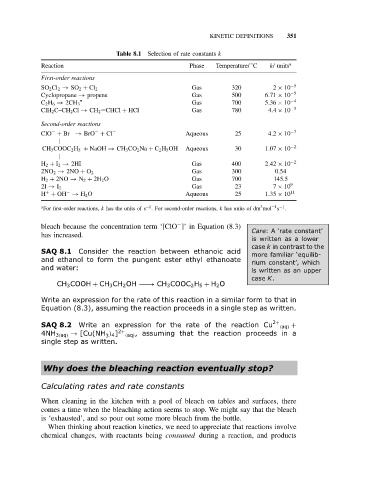
                                   Table 8.1  Selection of rate constants k
                                                                          ◦
             Reaction                                   Phase   Temperature/ C  k/ units a
             First-order reactions
                                                         Gas        320         2 × 10 −5
             SO 2 Cl 2 → SO 2 + Cl 2
             Cyclopropane → propene                      Gas        500       6.71 × 10 −5
                        ž                                                            −4
             C 2 H 6 → 2CH 3                             Gas        700       5.36 × 10
                              =CHCl + HCl                Gas        780        4.4 × 10 −3
             ClH 2 C–CH 2 Cl → CH 2
             Second-order reactions
                     −
                             −
             ClO + Br → BrO + Cl  −                    Aqueous       25        4.2 × 10 −7
                −
                  |
             CH 3 COOC 2 H 5 + NaOH → CH 3 CO 2 Na + C 2 H 5 OH  Aqueous  30  1.07 × 10 −2
                  |
             H 2 + I 2 → 2HI                             Gas        400       2.42 × 10 −2
             2NO 2 → 2NO + O 2                           Gas        300          0.54
             H 2 + 2NO → N 2 + 2H 2 O                    Gas        700         145.5
             2I → I 2                                    Gas         23         7 × 10 9
                    −
              +
             H + OH → H 2 O                            Aqueous       25       1.35 × 10 11
             a For first-order reactions, k has the units of s . For second-order reactions, k has units of dm mol s .
                                                                             3
                                           −1
                                                                                −1 −1
             bleach because the concentration term ‘[ClO ]’ in Equation (8.3)
                                                    −
                                                                          Care: A ‘rate constant’
             has increased.
                                                                          is written as a lower
                                                                          case k in contrast to the
             SAQ 8.1 Consider the reaction between ethanoic acid          more familiar ‘equilib-
             and ethanol to form the pungent ester ethyl ethanoate        rium constant’, which
             and water:                                                   is writtenasanupper
                                                                          case K.
                  CH 3 COOH + CH 3 CH 2 OH −−−→ CH 3 COOC 2 H 5 + H 2 O
             Write an expression for the rate of this reaction in a similar form to that in
             Equation (8.3), assuming the reaction proceeds in a single step as written.

             SAQ 8.2 Write an expression for the rate of the reaction Cu        2+ (aq) +
             4NH 3(aq) → [Cu(NH ) 4 ] 2+ (aq) , assuming that the reaction proceeds in a
                                3
             single step as written.


              Why does the bleaching reaction eventually stop?

             Calculating rates and rate constants

             When cleaning in the kitchen with a pool of bleach on tables and surfaces, there
             comes a time when the bleaching action seems to stop. We might say that the bleach
             is ‘exhausted’, and so pour out some more bleach from the bottle.
               When thinking about reaction kinetics, we need to appreciate that reactions involve
             chemical changes, with reactants being consumed during a reaction, and products

