


Page 379 - Physical chemistry understanding our chemical world
P. 379
346    ELECTROCHEMISTRY

                      zinc were then immersed in their respective solutions. The electrode reaction at the
                                                  −
                      zinc anode is Zn → Zn 2+  + 2e , while reduction occurs at the positive electrode,
                               −
                      Cu 2+  + 2e → Cu.
                        Although this battery was efficient, it was never popular because it required aqueous
                      solutions, which can be a danger if they slopped about. Its market share also suffered
                      when better batteries were introduced to the market.


                      The Leclanch´ e ‘dry-cell’ battery

                      The Leclanch´ e cell was first sold in 1880, and is still probably the most popular
                      battery in the world today, being needed for everyday applications such as torches,
                      radios, etc. It delivers an emf of ca 1.6 V.
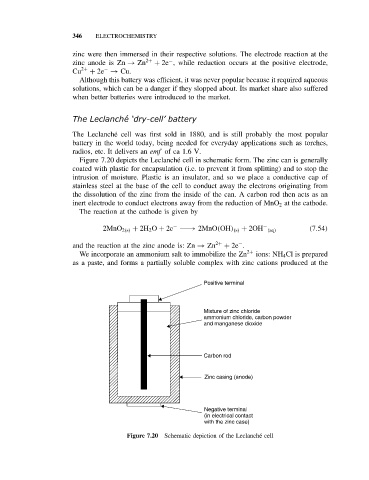
                        Figure 7.20 depicts the Leclanch´ e cell in schematic form. The zinc can is generally
                      coated with plastic for encapsulation (i.e. to prevent it from splitting) and to stop the
                      intrusion of moisture. Plastic is an insulator, and so we place a conductive cap of
                      stainless steel at the base of the cell to conduct away the electrons originating from
                      the dissolution of the zinc from the inside of the can. A carbon rod then acts as an
                      inert electrode to conduct electrons away from the reduction of MnO 2 at the cathode.
                        The reaction at the cathode is given by

                                                   −                         −
                               2MnO 2(s) + 2H 2 O + 2e −−→ 2MnO(OH) (s) + 2OH (aq)         (7.54)
                      and the reaction at the zinc anode is: Zn → Zn 2+  + 2e .
                                                                      −
                        We incorporate an ammonium salt to immobilize the Zn 2+  ions: NH 4 Cl is prepared
                      as a paste, and forms a partially soluble complex with zinc cations produced at the


                                                            Positive terminal


                                                            Mixture of zinc chloride
                                                            ammonium chloride, carbon powder
                                                            and manganese dioxide


                                                            Carbon rod


                                                            Zinc casing (anode)


                                                            Negative terminal
                                                            (in electrical contact
                                                            with the zinc case)

                                      Figure 7.20 Schematic depiction of the Leclanch´ e cell

