


Page 374 - Physical chemistry understanding our chemical world
P. 374
TRANSPORT PHENOMENA      341


                         +


                        Potential/V           potential           Rest potential
                                                                     Time t/ms
                                               Action


                         −


                                     Onset of impulse

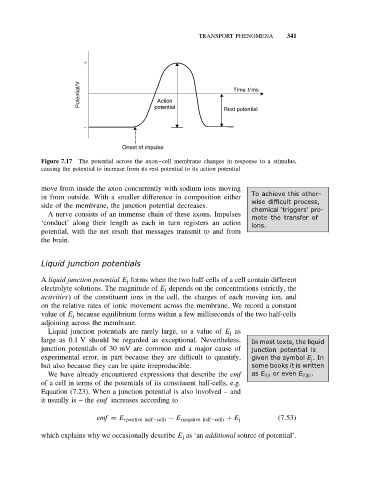
             Figure 7.17 The potential across the axon–cell membrane changes in response to a stimulus,
             causing the potential to increase from its rest potential to its action potential


             move from inside the axon concurrently with sodium ions moving
                                                                          To achieve this other-
             in from outside. With a smaller difference in composition either
                                                                          wise difficult process,
             side of the membrane, the junction potential decreases.
                                                                          chemical ‘triggers’ pro-
               A nerve consists of an immense chain of these axons. Impulses
                                                                          mote the transfer of
             ‘conduct’ along their length as each in turn registers an action  ions.
             potential, with the net result that messages transmit to and from
             the brain.

             Liquid junction potentials

             A liquid junction potential E j forms when the two half-cells of a cell contain different
             electrolyte solutions. The magnitude of E j depends on the concentrations (strictly, the
             activities) of the constituent ions in the cell, the charges of each moving ion, and
             on the relative rates of ionic movement across the membrane. We record a constant
             value of E j because equilibrium forms within a few milliseconds of the two half-cells
             adjoining across the membrane.
               Liquid junction potentials are rarely large, so a value of E j as
             large as 0.1 V should be regarded as exceptional. Nevertheless,  In most texts, the liquid
             junction potentials of 30 mV are common and a major cause of  junction potential is
             experimental error, in part because they are difficult to quantify,  given the symbol E j .In
             but also because they can be quite irreproducible.           some books it is written
               We have already encountered expressions that describe the emf  as E (lj) or even E (ljp) .
             of a cell in terms of the potentials of its constituent half-cells, e.g.
             Equation (7.23). When a junction potential is also involved – and
             it usually is – the emf increases according to

                                                                                  (7.53)
                             emf = E (positive half−cell) − E (negative half−cell) + E j
             which explains why we occasionally describe E j as ‘an additional source of potential’.

