


Page 377 - Physical chemistry understanding our chemical world
P. 377
344    ELECTROCHEMISTRY


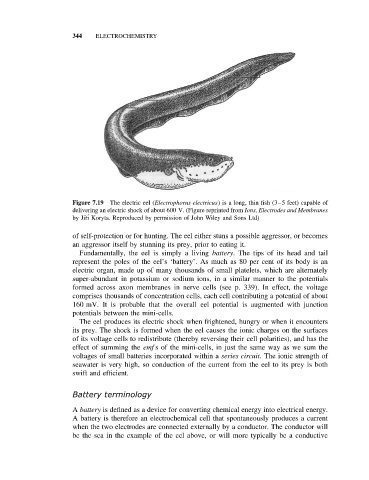
                      Figure 7.19 The electric eel (Electrophorus electricus) is a long, thin fish (3–5 feet) capable of
                      delivering an electric shock of about 600 V. (Figure reprinted from Ions, Electrodes and Membranes
                          ´
                      by Ji` ri Koryta. Reproduced by permission of John Wiley and Sons Ltd)
                      of self-protection or for hunting. The eel either stuns a possible aggressor, or becomes
                      an aggressor itself by stunning its prey, prior to eating it.
                        Fundamentally, the eel is simply a living battery. The tips of its head and tail
                      represent the poles of the eel’s ‘battery’. As much as 80 per cent of its body is an
                      electric organ, made up of many thousands of small platelets, which are alternately
                      super-abundant in potassium or sodium ions, in a similar manner to the potentials
                      formed across axon membranes in nerve cells (see p. 339). In effect, the voltage
                      comprises thousands of concentration cells, each cell contributing a potential of about
                      160 mV. It is probable that the overall eel potential is augmented with junction
                      potentials between the mini-cells.
                        The eel produces its electric shock when frightened, hungry or when it encounters
                      its prey. The shock is formed when the eel causes the ionic charges on the surfaces
                      of its voltage cells to redistribute (thereby reversing their cell polarities), and has the
                      effect of summing the emf s of the mini-cells, in just the same way as we sum the
                      voltages of small batteries incorporated within a series circuit. The ionic strength of
                      seawater is very high, so conduction of the current from the eel to its prey is both
                      swift and efficient.


                      Battery terminology

                      A battery is defined as a device for converting chemical energy into electrical energy.
                      A battery is therefore an electrochemical cell that spontaneously produces a current
                      when the two electrodes are connected externally by a conductor. The conductor will
                      be the sea in the example of the eel above, or will more typically be a conductive

