


Page 373 - Physical chemistry understanding our chemical world
P. 373
340    ELECTROCHEMISTRY


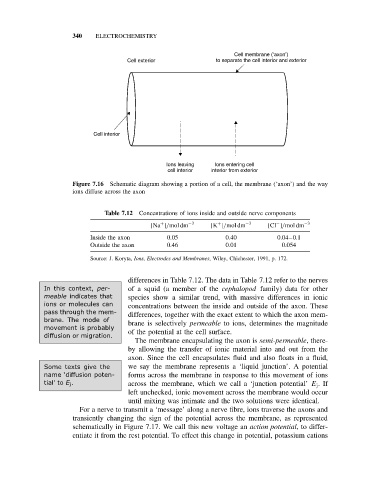
                                                                     Cell membrane (‘axon’)
                                      Cell exterior             to separate the cell interior and exterior


                            Cell interior


                                                 Ions leaving  Ions entering cell
                                                  cell interior  interior from exterior
                      Figure 7.16 Schematic diagram showing a portion of a cell, the membrane (‘axon’) and the way
                      ions diffuse across the axon


                               Table 7.12  Concentrations of ions inside and outside nerve components
                                             [Na ]/mol dm −3  [K ]/mol dm −3   [Cl ]/mol dm −3
                                                +
                                                                +
                                                                                 −
                           Inside the axon        0.05             0.40           0.04–0.1
                           Outside the axon       0.46             0.01            0.054
                           Source: J. Koryta, Ions, Electrodes and Membranes, Wiley, Chichester, 1991, p. 172.


                                      differences in Table 7.12. The data in Table 7.12 refer to the nerves
              In this context, per-   of a squid (a member of the cephalopod family) data for other
              meable indicates that   species show a similar trend, with massive differences in ionic
              ions or molecules can   concentrations between the inside and outside of the axon. These
              pass through the mem-   differences, together with the exact extent to which the axon mem-
              brane. Themodeof
                                      brane is selectively permeable to ions, determines the magnitude
              movement is probably    of the potential at the cell surface.
              diffusion or migration.
                                        The membrane encapsulating the axon is semi-permeable, there-
                                      by allowing the transfer of ionic material into and out from the
                                      axon. Since the cell encapsulates fluid and also floats in a fluid,
              Some texts give the     we say the membrane represents a ‘liquid junction’. A potential
              name ‘diffusion poten-  forms across the membrane in response to this movement of ions
              tial’ to E j .          across the membrane, which we call a ‘junction potential’ E j .If
                                      left unchecked, ionic movement across the membrane would occur
                                      until mixing was intimate and the two solutions were identical.
                        For a nerve to transmit a ‘message’ along a nerve fibre, ions traverse the axons and
                      transiently changing the sign of the potential across the membrane, as represented
                      schematically in Figure 7.17. We call this new voltage an action potential, to differ-
                      entiate it from the rest potential. To effect this change in potential, potassium cations

