


Page 369 - Physical chemistry understanding our chemical world
P. 369
336    ELECTROCHEMISTRY


                           The emf of the concentration cell, therefore, becomes
                                                RT            RT
                                          emf =    ln[a (O)RHS ] −  ln[a (O)LHS ]
                                                nF             nF
                         which, through the laws of logarithms, simplifies readily to yield Equation (7.48).
                           If we assume that the activity coefficients in the left- and right-hand half-cells are the
                         same (which would certainly be a very reasonable assumption if a swamping electrolyte
                         was also in solution), then the activity coefficients would cancel to yield

                                                      RT     [O] RHS
                                                emf =     ln
                                                      nF     [O] LHS


                       How do pH electrodes work?

                      The pH–glass electrode


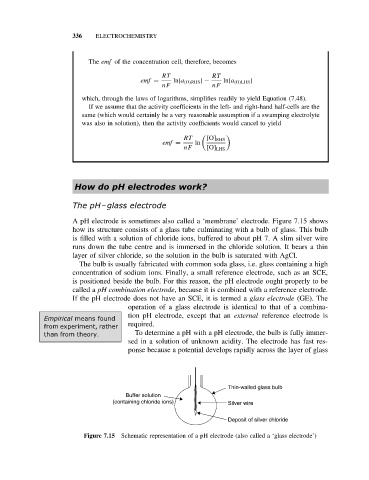
                      A pH electrode is sometimes also called a ‘membrane’ electrode. Figure 7.15 shows
                      how its structure consists of a glass tube culminating with a bulb of glass. This bulb
                      is filled with a solution of chloride ions, buffered to about pH 7. A slim silver wire
                      runs down the tube centre and is immersed in the chloride solution. It bears a thin
                      layer of silver chloride, so the solution in the bulb is saturated with AgCl.
                        The bulb is usually fabricated with common soda glass, i.e. glass containing a high
                      concentration of sodium ions. Finally, a small reference electrode, such as an SCE,
                      is positioned beside the bulb. For this reason, the pH electrode ought properly to be
                      called a pH combination electrode, because it is combined with a reference electrode.
                      If the pH electrode does not have an SCE, it is termed a glass electrode (GE). The
                                      operation of a glass electrode is identical to that of a combina-
                                      tion pH electrode, except that an external reference electrode is
              Empirical means found
              from experiment, rather  required.
              than from theory.         To determine a pH with a pH electrode, the bulb is fully immer-
                                      sed in a solution of unknown acidity. The electrode has fast res-
                                      ponse because a potential develops rapidly across the layer of glass


                                                                   Thin-walled glass bulb
                                     Buffer solution
                                  (containing chloride ions)       Silver wire


                                                                   Deposit of silver chloride

                         Figure 7.15  Schematic representation of a pH electrode (also called a ‘glass electrode’)

