


Page 364 - Physical chemistry understanding our chemical world
P. 364
HALF-CELLS AND THE NERNST EQUATION     331


                                                    Lead to voltmeter


                                                    Glass tube

                                                    Platinum contact
                                                    Saturated KCl solution

                                                    Paste of Hg and Hg 2 Cl 2


                                                    Crystals of KCl
                                                    Porous sinter

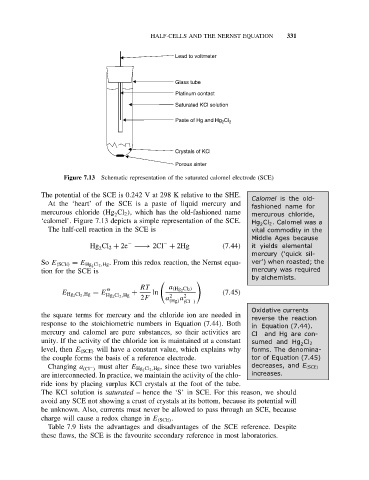
                    Figure 7.13 Schematic representation of the saturated calomel electrode (SCE)

             The potential of the SCE is 0.242 V at 298 K relative to the SHE.
                                                                          Calomel is the old-
               At the ‘heart’ of the SCE is a paste of liquid mercury and  fashioned name for
             mercurous chloride (Hg Cl 2 ), which has the old-fashioned name
                                  2                                       mercurous chloride,
             ‘calomel’. Figure 7.13 depicts a simple representation of the SCE.  Hg Cl 2 .Calomel wasa
                                                                            2
               The half-cell reaction in the SCE is                       vital commodity in the
                                                                          Middle Ages because
                                                −
                                      −
                           Hg Cl 2 + 2e −−→ 2Cl + 2Hg             (7.44)  it yields elemental
                              2
                                                                          mercury (‘quick sil-
             So E (SCE) = E Hg 2 Cl 2 ,Hg . From this redox reaction, the Nernst equa-  ver’) when roasted; the
             tion for the SCE is                                          mercury was required
                                                                          by alchemists.

                                          RT      a (Hg 2 Cl 2 )
                   E Hg 2 Cl 2 ,Hg = E  O  +  ln                  (7.45)
                                Hg 2 Cl 2 ,Hg     2   2
                                          2F     a   a
                                                        −
                                                  (Hg) (Cl )
                                                                          Oxidative currents
             the square terms for mercury and the chloride ion are needed in
                                                                          reverse the reaction
             response to the stoichiometric numbers in Equation (7.44). Both  in Equation (7.44).
             mercury and calomel are pure substances, so their activities are  Cl −  and Hg are con-
             unity. If the activity of the chloride ion is maintained at a constant  sumed and Hg Cl 2
                                                                                        2
             level, then E (SCE) will have a constant value, which explains why  forms. The denomina-
             the couple forms the basis of a reference electrode.         tor of Equation (7.45)
               Changing a (Cl )                                           decreases, and E (SCE)
                           − must alter E Hg 2 Cl 2 ,Hg , since these two variables
             are interconnected. In practice, we maintain the activity of the chlo-  increases.
             ride ions by placing surplus KCl crystals at the foot of the tube.
             The KCl solution is saturated – hence the ‘S’ in SCE. For this reason, we should
             avoid any SCE not showing a crust of crystals at its bottom, because its potential will
             be unknown. Also, currents must never be allowed to pass through an SCE, because
             charge will cause a redox change in E (SCE) .
               Table 7.9 lists the advantages and disadvantages of the SCE reference. Despite
             these flaws, the SCE is the favourite secondary reference in most laboratories.

