


Page 361 - Physical chemistry understanding our chemical world
P. 361
328    ELECTROCHEMISTRY


                       Why ‘earth’ a plug?

                      Reference electrodes

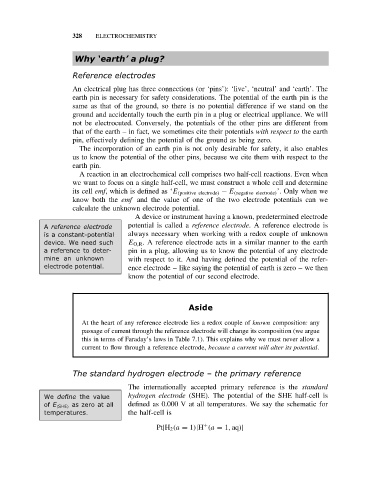
                      An electrical plug has three connections (or ‘pins’): ‘live’, ‘neutral’ and ‘earth’. The
                      earth pin is necessary for safety considerations. The potential of the earth pin is the
                      same as that of the ground, so there is no potential difference if we stand on the
                      ground and accidentally touch the earth pin in a plug or electrical appliance. We will
                      not be electrocuted. Conversely, the potentials of the other pins are different from
                      that of the earth – in fact, we sometimes cite their potentials with respect to the earth
                      pin, effectively defining the potential of the ground as being zero.
                        The incorporation of an earth pin is not only desirable for safety, it also enables
                      us to know the potential of the other pins, because we cite them with respect to the
                      earth pin.
                        A reaction in an electrochemical cell comprises two half-cell reactions. Even when
                      we want to focus on a single half-cell, we must construct a whole cell and determine
                      its cell emf, which is defined as ‘E (positive electrode) − E (negative electrode) ’. Only when we
                      know both the emf and the value of one of the two electrode potentials can we
                      calculate the unknown electrode potential.
                                        A device or instrument having a known, predetermined electrode
              A reference electrode   potential is called a reference electrode. A reference electrode is
              is a constant-potential  always necessary when working with a redox couple of unknown
              device. We need such    E O,R . A reference electrode acts in a similar manner to the earth
              a reference to deter-   pin in a plug, allowing us to know the potential of any electrode
              mine an unknown         with respect to it. And having defined the potential of the refer-
              electrode potential.    ence electrode – like saying the potential of earth is zero – we then
                                      know the potential of our second electrode.


                                                        Aside

                         At the heart of any reference electrode lies a redox couple of known composition: any
                         passage of current through the reference electrode will change its composition (we argue
                         this in terms of Faraday’s laws in Table 7.1). This explains why we must never allow a
                         current to flow through a reference electrode, because a current will alter its potential.


                      The standard hydrogen electrode – the primary reference

                                      The internationally accepted primary reference is the standard
              We define the value      hydrogen electrode (SHE). The potential of the SHE half-cell is
              of E (SHE) as zero at all  defined as 0.000 V at all temperatures. We say the schematic for
              temperatures.           the half-cell is

                                                            +
                                              Pt|H 2 (a = 1)|H (a = 1, aq)|

