


Page 362 - Physical chemistry understanding our chemical world
P. 362
HALF-CELLS AND THE NERNST EQUATION     329

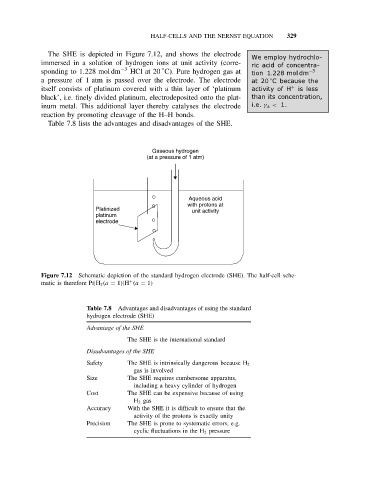
               The SHE is depicted in Figure 7.12, and shows the electrode
                                                                          We employ hydrochlo-
             immersed in a solution of hydrogen ions at unit activity (corre-  ric acid of concentra-
                                                ◦
             sponding to 1.228 mol dm −3  HClat20 C). Pure hydrogen gas at  tion 1.228 mol dm −3
             a pressure of 1 atm is passed over the electrode. The electrode  at 20 Cbecause the
                                                                               ◦
             itself consists of platinum covered with a thin layer of ‘platinum  activity of H +  is less
             black’, i.e. finely divided platinum, electrodeposited onto the plat-  than its concentration,
             inum metal. This additional layer thereby catalyses the electrode  i.e. γ ± < 1.
             reaction by promoting cleavage of the H–H bonds.
               Table 7.8 lists the advantages and disadvantages of the SHE.


                                             Gaseous hydrogen
                                            (at a pressure of 1 atm)


                                                        Aqueous acid
                                                       with protons at
                             Platinized                  unit activity
                             platinum
                             electrode


             Figure 7.12 Schematic depiction of the standard hydrogen electrode (SHE). The half-cell sche-
                                       +
             matic is therefore Pt|H 2 (a = 1)|H (a = 1)


                          Table 7.8  Advantages and disadvantages of using the standard
                          hydrogen electrode (SHE)
                          Advantage of the SHE
                                      The SHE is the international standard
                          Disadvantages of the SHE
                          Safety      The SHE is intrinsically dangerous because H 2
                                        gas is involved
                          Size        The SHE requires cumbersome apparatus,
                                        including a heavy cylinder of hydrogen
                          Cost        The SHE can be expensive because of using
                                        H 2 gas
                          Accuracy    With the SHE it is difficult to ensure that the
                                        activity of the protons is exactly unity
                          Precision   The SHE is prone to systematic errors, e.g.
                                        cyclic fluctuations in the H 2 pressure

