


Page 367 - Physical chemistry understanding our chemical world
P. 367
334    ELECTROCHEMISTRY


                                                           V
                                                                                Humid air
                                                                                 Steel


                                          Sulphur cluster:              steel having a
                                         area of steel having           relatively high
                                       a low mole fraction of iron    mole fraction of iron
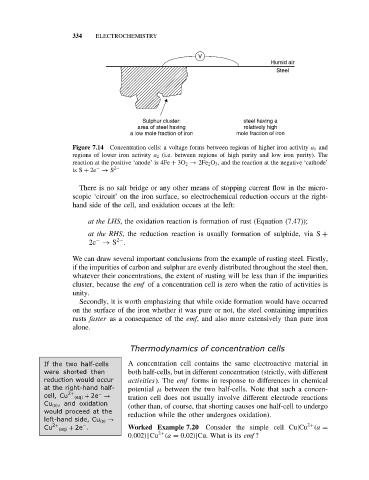
                      Figure 7.14 Concentration cells: a voltage forms between regions of higher iron activity a 1 and
                      regions of lower iron activity a 2 (i.e. between regions of high purity and low iron purity). The
                      reaction at the positive ‘anode’ is 4Fe + 3O 2 → 2Fe 2 O 3 , and the reaction at the negative ‘cathode’
                      is S + 2e → S 2−
                             −

                        There is no salt bridge or any other means of stopping current flow in the micro-
                      scopic ‘circuit’ on the iron surface, so electrochemical reduction occurs at the right-
                      hand side of the cell, and oxidation occurs at the left:

                           at the LHS, the oxidation reaction is formation of rust (Equation (7.47));
                           at the RHS, the reduction reaction is usually formation of sulphide, via S +
                             −
                                   2−
                           2e → S .
                      We can draw several important conclusions from the example of rusting steel. Firstly,
                      if the impurities of carbon and sulphur are evenly distributed throughout the steel then,
                      whatever their concentrations, the extent of rusting will be less than if the impurities
                      cluster, because the emf of a concentration cell is zero when the ratio of activities is
                      unity.
                        Secondly, it is worth emphasizing that while oxide formation would have occurred
                      on the surface of the iron whether it was pure or not, the steel containing impurities
                      rusts faster as a consequence of the emf, and also more extensively than pure iron
                      alone.

                                       Thermodynamics of concentration cells


              If the two half-cells   A concentration cell contains the same electroactive material in
              were shorted then       both half-cells, but in different concentration (strictly, with different
              reduction would occur   activities). The emf forms in response to differences in chemical
              at the right-hand half-  potential µ between the two half-cells. Note that such a concen-
              cell, Cu 2+ (aq) + 2e →  tration cell does not usually involve different electrode reactions
                              −
              Cu (s) , and oxidation  (other than, of course, that shorting causes one half-cell to undergo
              would proceed at the
                                      reduction while the other undergoes oxidation).
              left-hand side, Cu (s) →
                                                                                          2+
                         −
              Cu 2+ (aq) + 2e .       Worked Example 7.20 Consider the simple cell Cu|Cu (a =
                                               2+
                                      0.002)||Cu (a = 0.02)|Cu. What is its emf ?

