


Page 368 - Physical chemistry understanding our chemical world
P. 368
CONCENTRATION CELLS     335

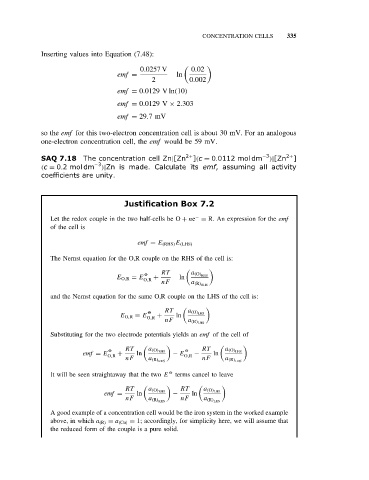
             Inserting values into Equation (7.48):

                                          0.0257 V       0.02
                                   emf =            ln
                                             2          0.002
                                   emf = 0.0129 V ln(10)
                                   emf = 0.0129 V × 2.303

                                   emf = 29.7mV

             so the emf for this two-electron concentration cell is about 30 mV. For an analogous
             one-electron concentration cell, the emf wouldbe59mV.

             SAQ 7.18 The concentration cell Zn|[Zn    2+ ](c = 0.0112 mol dm −3 )|[Zn  2+ ]
             (c = 0.2mol dm −3 )|Zn is made. Calculate its emf, assuming all activity
             coefficients are unity.


                                     Justification Box 7.2

                Let the redox couple in the two half-cells be O + ne = R. An expression for the emf
                                                          −
                of the cell is

                                         emf = E (RHS) E (LHS)
                The Nernst equation for the O,R couple on the RHS of the cell is:


                                                RT      a (O) RHS
                                   E O,R = E  O  +   ln
                                           O,R
                                                nF       a (R) RHS
                and the Nernst equation for the same O,R couple on the LHS of the cell is:
                                                 RT      a (O) LHS
                                    E O,R = E  O  +  ln
                                            O,R
                                                 nF     a (R) LHS
                Substituting for the two electrode potentials yields an emf of the cell of

                                     RT       a (O) RHS     O  RT     a (O) LHS
                                 O
                         emf = E O,R  +  ln        − E O,R  −  ln
                                     nF     a (R) RHS       nF    a (R) LHS
                It will be seen straightaway that the two E  O  terms cancel to leave
                                     RT       a (O) RHS     RT     a (O) LHS
                               emf =     ln        −     ln
                                     nF     a (R) RHS  nF   a (R) LHS
                A good example of a concentration cell would be the iron system in the worked example
                above, in which a (R) = a (Cu) = 1; accordingly, for simplicity here, we will assume that
                the reduced form of the couple is a pure solid.

