


Page 111 - Physical chemistry eng
P. 111
88     CHAPTER 5 Entropy and the Second and Third Laws of Thermodynamics

                                         surroundings in the first two segments and on the system in the last two segments. An
                                         engine is only useful if net work is done on the surroundings, that is, if the magnitude of the
                                         work done in the first two steps is greater than the magnitude of the work done in the last
                                         two steps. The efficiency of the engine can be calculated by comparing the net work per
                                         cycle with the heat taken up by the engine from the hot reservoir.
                                            Before carrying out this calculation, we discuss the rationale for the design of this
                                         reversible cycle in more detail. To avoid losing heat to the surroundings at temperatures
                                         between T hot  and T cold , adiabatic segments 2 (b : c)  and 4 (d : a)  are used to move the
                                         gas between these temperatures. To absorb heat only at T hot  and release heat only at T cold ,
                                         segments 1 (a : b)  and 3 (c : d)  must be isothermal. The reason for using alternating
                                         isothermal and adiabatic segments is that no two isotherms at different temperatures inter-
                                         sect, and no two adiabats starting from two different temperatures intersect. Therefore, it
                                         is impossible to create a closed cycle of nonzero area in an indicator diagram out of
                                         isothermal or adiabatic segments alone. However, net work can be done using alternating
                                         adiabatic and isothermal segments. The reversible cycle depicted in Figure 5.2 is called a
                                         Carnot cycle, after the French engineer who first studied such cycles.
                                            The efficiency of the Carnot cycle can be determined by calculating q, w, and ¢U
                                         for each segment of the cycle, assuming that the working substance is an ideal gas. The
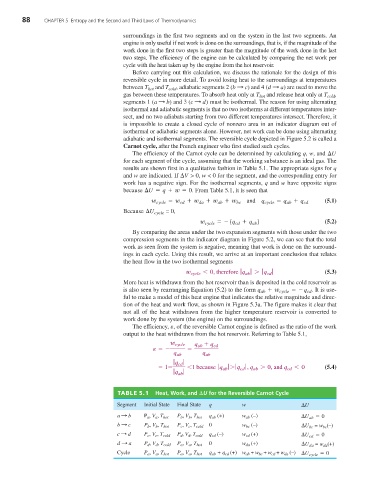
                                         results are shown first in a qualitative fashion in Table 5.1. The appropriate signs for q
                                         and w are indicated. If ¢V  > 0, w < 0 for the segment, and the corresponding entry for
                                         work has a negative sign. For the isothermal segments, q and w have opposite signs
                                         because ¢U = q + w = 0 . From Table 5.1, it is seen that
                                                  w cycle  = w cd  + w da  + w ab  + w   and  q cycle  = q ab  + q cd  (5.1)
                                                                              bc
                                         Because ¢U cycle  = 0,
                                                                        =- (q   + q )                      (5.2)
                                                                  w cycle     cd   ab
                                            By comparing the areas under the two expansion segments with those under the two
                                         compression segments in the indicator diagram in Figure 5.2, we can see that the total
                                         work as seen from the system is negative, meaning that work is done on the surround-
                                         ings in each cycle. Using this result, we arrive at an important conclusion that relates
                                         the heat flow in the two isothermal segments
                                                              w cycle  6 0, therefore ƒ q ƒ 7 ƒ q cd  ƒ    (5.3)
                                                                                 ab
                                         More heat is withdrawn from the hot reservoir than is deposited in the cold reservoir as
                                         is also seen by rearranging Equation (5.2) to the form q ab  + w cycle  =- q cd . It is use-
                                         ful to make a model of this heat engine that indicates the relative magnitude and direc-
                                         tion of the heat and work flow, as shown in Figure 5.3a. The figure makes it clear that
                                         not all of the heat withdrawn from the higher temperature reservoir is converted to
                                         work done by the system (the engine) on the surroundings.
                                                         e
                                            The efficiency,  , of the reversible Carnot engine is defined as the ratio of the work
                                         output to the heat withdrawn from the hot reservoir. Referring to Table 5.1,
                                                         w cycle  q  + q
                                                     e =-     =   ab   cd
                                                          q ab     q ab
                                                          ƒ q ƒ
                                                      = 1-  cd   61 because  ƒ q ƒ 7 ƒ q ƒ , q ab  7 0, and q cd  6 0  (5.4)
                                                                          ab
                                                                               cd
                                                          ƒ q ab  ƒ

                                       TABLE 5.1    Heat, Work, and ¢U  for the Reversible Carnot Cycle
                                       Segment  Initial State  Final State  q   w                  ¢U
                                       a : b    P a , V a , T hot  P b , V b , T hot  q ab (+)  w ab (–)  ¢U ab = 0
                                       b : c    P b , V b , T hot  P c , V c , T cold  0  w bc (–)  ¢U bc  = w bc (–)
                                       c : d    P c , V c , T cold  P d , V d , T cold  q cd (–)  w cd (+)  ¢U cd = 0
                                       d : a    P d , V d , T cold  P a , V a , T hot  0  w da (+)  ¢U da  = w da (+)
                                       Cycle    P a , V a , T hot  P a , V a , T hot  q ab + q cd (+) w ab + w bc + w cd + w da (–)  ¢U cycle = 0

