


Page 110 - Physical chemistry eng
P. 110
5.2 HEAT ENGINES AND THE SECOND LAW OF THERMODYNAMICS  87

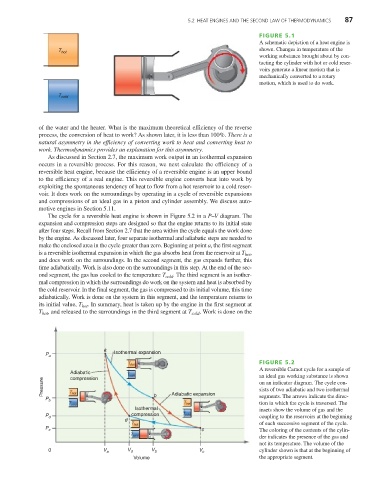
                                                                                      FIGURE 5.1
                                                                                      A schematic depiction of a heat engine is
                    T hot                                                             shown. Changes in temperature of the
                                                                                      working substance brought about by con-
                                                                                      tacting the cylinder with hot or cold reser-
                                                                                      voirs generate a linear motion that is
                                                                                      mechanically converted to a rotary
                                                                                      motion, which is used to do work.
                    T cold


              of the water and the heater. What is the maximum theoretical efficiency of the reverse
              process, the conversion of heat to work? As shown later, it is less than 100%. There is a
              natural asymmetry in the efficiency of converting work to heat and converting heat to
              work. Thermodynamics provides an explanation for this asymmetry.
                 As discussed in Section 2.7, the maximum work output in an isothermal expansion
              occurs in a reversible process. For this reason, we next calculate the efficiency of a
              reversible heat engine, because the efficiency of a reversible engine is an upper bound
              to the efficiency of a real engine. This reversible engine converts heat into work by
              exploiting the spontaneous tendency of heat to flow from a hot reservoir to a cold reser-
              voir. It does work on the surroundings by operating in a cycle of reversible expansions
              and compressions of an ideal gas in a piston and cylinder assembly. We discuss auto-
              motive engines in Section 5.11.
                 The cycle for a reversible heat engine is shown in Figure 5.2 in a P–V diagram. The
              expansion and compression steps are designed so that the engine returns to its initial state
              after four steps. Recall from Section 2.7 that the area within the cycle equals the work done
              by the engine. As discussed later, four separate isothermal and adiabatic steps are needed to
              make the enclosed area in the cycle greater than zero. Beginning at point a, the first segment
              is a reversible isothermal expansion in which the gas absorbs heat from the reservoir at T ,
                                                                                 hot
              and does work on the surroundings. In the second segment, the gas expands further, this
              time adiabatically. Work is also done on the surroundings in this step. At the end of the sec-
              ond segment, the gas has cooled to the temperature T cold . The third segment is an isother-
              mal compression in which the surroundings do work on the system and heat is absorbed by
              the cold reservoir. In the final segment, the gas is compressed to its initial volume, this time
              adiabatically. Work is done on the system in this segment, and the temperature returns to
              its initial value, T . In summary, heat is taken up by the engine in the first segment at
                            hot
              T , and released to the surroundings in the third segment at T cold . Work is done on the
               hot


                                   a
                P a                   Isothermal expansion
                                                                                      FIGURE 5.2
                                           T hot
                                                                                      A reversible Carnot cycle for a sample of
                        Adiabatic
                                          T cold                                      an ideal gas working substance is shown
                        compression
               Pressure                                                               on an indicator diagram. The cycle con-
                                                                                      sists of two adiabatic and two isothermal
                P b     T hot                      b     Adiabatic expansion          segments. The arrows indicate the direc-
                                                             T hot                    tion in which the cycle is traversed. The
                       T cold
                                             Isothermal                               insets show the volume of gas and the
                P d                         compression      T cold                   coupling to the reservoirs at the beginning
                                          d
                                            T hot                                     of each successive segment of the cycle.
                P c                                                c                  The coloring of the contents of the cylin-
                                            T cold
                                                                                      der indicates the presence of the gas and
                                                                                      not its temperature. The volume of the
                 0                 V a     V d    V b             V c                 cylinder shown is that at the beginning of
                                             Volume                                   the appropriate segment.

