


Page 105 - Physical chemistry eng
P. 105
82     CHAPTER 4 Thermochemistry

        Q4.17 Under what conditions are ¢H  and ¢U  for a reac-  Q4.19 Is ¢ H for breaking the first C—H bond in methane
        tion involving gases and/or liquids or solids identical?  equal to the average C—H bond enthalpy in this molecule?
                                                             Explain your answer.
        Q4.18  Dogs cool off in hot weather by panting.
        Write a chemical equation to describe this process and   Q4.20  Humans cool off through perspiration. How does the
        calculate ¢H° R .                                    effectiveness of this process depend on the relative humidity?

        Numerical Problems


        Problem numbers in red indicate that the solution to the  Calculate ¢H° R  for
        problem is given in the Student’s Solutions Manual.  a. OH(g) ¡ H(g) + O(g)
        P4.1  Given the data in Table 4.1 (Appendix B, Data Tables)  b. H O(g) ¡ 2 H(g) + O(g)
                                                                 2
        and the following information, calculate the single bond
                                                             c. H O(g) ¡ H(g) + OH(g)
                                                                 2
        enthalpies and energies for Si–F, Si–Cl, C–F, N–F, O–F, H–F:
                                                             Assuming ideal gas behavior, calculate ¢H° and ¢U° R  for all
                                                                                                R
        Substance     SiF (g) SiCl (g)CF (g) NF (g) OF (g) HF(g)  three reactions.
                                4
                         4
                                      4
                                                  2
                                            3
                   -1
        ¢H° f  (kJ mol ) -1614.9 -657.0 -925 -125  -22 -271  P4.9 Calculate the standard enthalpy of formation of FeS 2 (s)
        P4.2 At 1000. K, ¢H° R  = –123.77 kJ mol -1  for the reaction  at 600.°C from the following data at 298.15 K. Assume that the
        N (g) + 3 H (g) ¡  2  NH (g), with C P,m  = 3.502R, 3.466R,  heat capacities are independent of temperature.
                               3
          2
                  2
        and 4.217R for N (g), H (g), and NH (g), respectively.  Substance  Fe(s) FeS (s) Fe O (s) S(rhombic) SO (g)
                                     3
                           2
                      2
                                                                                                           2
                                                                                          3
                                                                                  2
                                                                                        2
        Calculate ¢H° f  of NH 3 (g) at 450. K from this information.  ¢H° (kJ mol )  –824.2            -296.81
                                                                       –1
        Assume that the heat capacities are independent of temperature.  f
                                                              C   > R      3.02  7.48            2.72
        P4.3  A sample of K(s) of mass 2.740 g undergoes       P,m
        combustion in a constant volume calorimeter at 298.15 K.  You are also given that for the reaction 2 FeS (s) + 11>2  O (g)
                                                                                                 2
                                      –1
        The calorimeter constant is 1849 J K , and the measured  ¡  Fe O (s) + 4 SO (g), ¢H°  =-1655 kJ mol .  2
                                                                                                     -1
        temperature rise in the inner water bath containing 1450. g of  2 3     2      R
        water is 1.60 K. Calculate ¢U° f  and ¢H° f  for K O.  P4.10 The following data are a DSC scan of a solution of a
                                              2
                                                             T4 lysozyme mutant. From the data determine T . Determine
                                                                                                    m
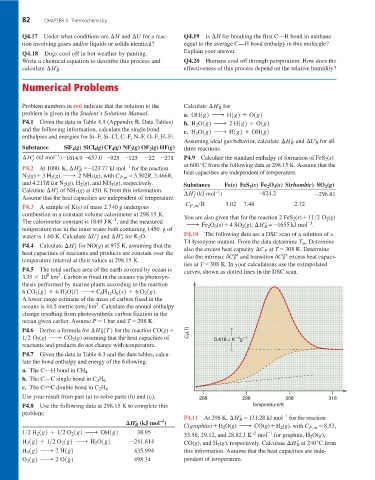
        P4.4  Calculate ¢H° f  for NO(g) at 975 K, assuming that the  also the excess heat capacity ¢C  at T = 308 K. Determine
        heat capacities of reactants and products are constant over the      int       P     trs
                                                             also the intrinsic dC P  and transition dC P  excess heat capaci-
        temperature interval at their values at 298.15 K.
                                                             ties at T = 308 K. In your calculations use the extrapolated
        P4.5  The total surface area of the earth covered by ocean is  curves, shown as dotted lines in the DSC scan.
                8
                    2
        3.35 * 10  km .  Carbon is fixed in the oceans via photosyn-
        thesis performed by marine plants according to the reaction
        6 CO 2 (g) + 6 H 2 O(l) ¡ C 6 H 12 O 6 (s) + 6 O 2 (g) .
        A lower range estimate of the mass of carbon fixed in the
                             >
                                2
        oceans is 44.5 metric tons km . Calculate the annual enthalpy
        change resulting from photosynthetic carbon fixation in the
        ocean given earlier. Assume P = 1 bar and T = 298 K.
        P4.6 Derive a formula for ¢H°(T)  for the reaction CO(g) +  C P (T)
                                  R
        1>2  O (g) ¡  CO (g) assuming that the heat capacities of      0.418 J K  1  1
             2
                         2
                                                                               g
        reactants and products do not change with temperature.
        P4.7  Given the data in Table 4.3 and the data tables, calcu-
        late the bond enthalpy and energy of the following:
        a. The C—H bond in CH 4
        b. The C—C single bond in C H
                                 2 6
        c. The C—C double bond in C H
                                 2 4
        Use your result from part (a) to solve parts (b) and (c).  288          298           308           318
        P4.8  Use the following data at 298.15 K to complete this                  Temperature/K
        problem:                                                                             -1
                                                             P4.11 At 298 K, ¢H° R  = 131.28 kJ mol  for the reaction
                                                     –1
                                          ≤H° R  (kJ mol )   C(graphite) + H O(g) ¡  CO(g) + H (g), with C P, m  = 8.53,
                                                                                             2
                                                                          2
        1>2 H 2 (g) + 1>2 O 2 (g) ¡ OH(g)     38.95                                –1   -1
                                                             33.58, 29.12, and 28.82 J K mol  for graphite, H O(g),
                                                                                                      2
        H 2 (g) + 1>2 O 2 (g) ¡ H 2 O(g)    -241.814         CO(g), and H (g), respectively. Calculate ¢H R    at 240°C from
                                                                        2
        H 2 (g) ¡ 2 H(g)                     435.994         this information. Assume that the heat capacities are inde-
        O 2 (g) ¡ 2 O(g)                     498.34          pendent of temperature.

