


Page 112 - Physical chemistry eng
P. 112
5.2 HEAT ENGINES AND THE SECOND LAW OF THERMODYNAMICS  89

              Both q ab  and q cd  are nonzero because the corresponding processes are isothermal.  Hot reservoir
              Equation (5.4) shows that the efficiency of a heat engine operating in a reversible
              Carnot cycle is always less than one. Equivalently, not all of the heat withdrawn
              from the hot reservoir can be converted to work. This conclusion is valid for all
              engines and illustrates the asymmetry in converting heat to work and work to heat.
                 These considerations on the efficiency of reversible heat engines led to the
              Kelvin–Planck formulation of the second law of thermodynamics:


                It is impossible for a system to undergo a cyclic process whose sole effects are            Work
                the flow of heat into the system from a heat reservoir and the performance of an
                equal amount of work by the system on the surroundings.


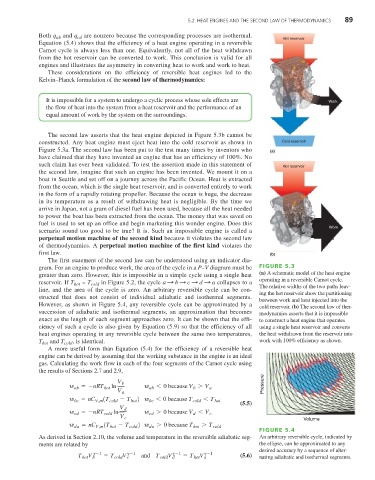
                 The second law asserts that the heat engine depicted in Figure 5.3b cannot be
              constructed. Any heat engine must eject heat into the cold reservoir as shown in  Cold reservoir
              Figure 5.3a. The second law has been put to the test many times by inventors who  (a)
              have claimed that they have invented an engine that has an efficiency of 100%. No
              such claim has ever been validated. To test the assertion made in this statement of  Hot reservoir
              the second law, imagine that such an engine has been invented. We mount it on a
              boat in Seattle and set off on a journey across the Pacific Ocean. Heat is extracted
              from the ocean, which is the single heat reservoir, and is converted entirely to work
              in the form of a rapidly rotating propeller. Because the ocean is huge, the decrease
              in its temperature as a result of withdrawing heat is negligible. By the time we
              arrive in Japan, not a gram of diesel fuel has been used, because all the heat needed
              to power the boat has been extracted from the ocean. The money that was saved on
              fuel is used to set up an office and begin marketing this wonder engine. Does this
                                                                                                            Work
              scenario sound too good to be true? It is. Such an impossible engine is called a
              perpetual motion machine of the second kind because it violates the second law
              of thermodynamics. A perpetual motion machine of the first kind violates the
              first law.                                                                 (b)
                 The first statement of the second law can be understood using an indicator dia-
              gram. For an engine to produce work, the area of the cycle in a P–V diagram must be  FIGURE 5.3
              greater than zero. However, this is impossible in a simple cycle using a single heat  (a) A schematic model of the heat engine
                                                                                      operating in a reversible Carnot cycle.
              reservoir. If T hot  = T cold  in Figure 5.2, the cycle a : b : c : d : a  collapses to a
              line, and the area of the cycle is zero. An arbitrary reversible cycle can be con-  The relative widths of the two paths leav-
                                                                                      ing the hot reservoir show the partitioning
              structed that does not consist of individual adiabatic and isothermal segments.
                                                                                      between work and heat injected into the
              However, as shown in Figure 5.4, any reversible cycle can be approximated by a
                                                                                      cold reservoir. (b) The second law of ther-
              succession of adiabatic and isothermal segments, an approximation that becomes  modynamics asserts that it is impossible
              exact as the length of each segment approaches zero. It can be shown that the effi-  to construct a heat engine that operates
              ciency of such a cycle is also given by Equation (5.9) so that the efficiency of all  using a single heat reservoir and converts
              heat engines operating in any reversible cycle between the same two temperatures,  the heat withdrawn from the reservoir into
              T hot  and T cold , is identical.                                       work with 100% efficiency as shown.
                 A more useful form than Equation (5.4) for the efficiency of a reversible heat
              engine can be derived by assuming that the working substance in the engine is an ideal
              gas. Calculating the work flow in each of the four segments of the Carnot cycle using
              the results of Sections 2.7 and 2.9,
                                       V b
                        w ab  =-nRT hot  ln     w ab  6 0 because V 7 V a              Pressure
                                                                b
                                       V a
                        w bc  = nC V,m (T cold  - T hot )w bc  6 0 because T cold  6 T hot
                                                                               (5.5)
                                        V d
                        w cd  =-nRT cold  ln    w cd  7 0 because V 6 V c
                                                                d
                                        V c                                                         Volume
                        w da  = nC V,m (T hot  - T cold )w da  7 0 because T hot  7 T cold
                                                                                      FIGURE 5.4
              As derived in Section 2.10, the volume and temperature in the reversible adiabatic seg-  An arbitrary reversible cycle, indicated by
              ments are related by                                                    the ellipse, can be approximated to any
                                                                                      desired accuracy by a sequence of alter-
                              V
                                         V   and  T
                           T hot b g-1  = T cold c g-1  cold d g-1  = T hot a g-1  (5.6)  nating adiabatic and isothermal segments.
                                                        V
                                                                  V

