


Page 118 - Physical chemistry eng
P. 118
5.4 CALCULATING CHANGES IN ENTROPY  95

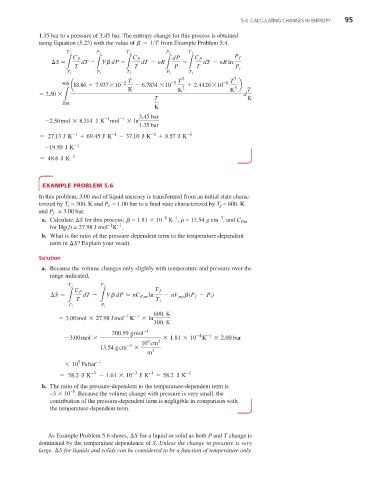
              1.35 bar to a pressure of 3.45 bar. The entropy change for this process is obtained
              using Equation (5.23) with the value of b = 1>T  from Example Problem 5.4.

                       T f      P f       T f          P f     T f
                         C P                C P          dP      C P          P f
                  ¢S =      dT -  Vb dP =      dT - nR       =     dT - nR ln
                         T                   T            P      T            P i
                       3        3         3            3      3
                       T i       P i      T i          P i     T i
                                           T               T 2              T 3
                                                         -5
                                                                          -8
                                        -2
                     800.  a18.86 + 7.937 * 10    - 6.7834 * 10    + 2.4426 * 10    b
                                           K               K 2              K 3   T
               = 2.50 *                                                         d
                                                   T                              K
                      3
                     450.
                                                   K
                                              3.45 bar
                                   -1
                                        -1
                 -2.50mol * 8.314  J K mol  * ln
                                              1.35 bar
               =  27.13 J K -1  + 69.45 J K -1  - 37.10 J K -1  + 8.57 J K -1
                 -19.50 J K -1
               =  48.6 J K -1

               EXAMPLE PROBLEM 5.6
              In this problem, 3.00 mol of liquid mercury is transformed from an initial state charac-
              terized by T = 300. K and P = 1.00 bar to a final state characterized by T = 600. K
                                    i
                       i
                                                                         f
              and P = 3.00 bar.
                  f
                                                                        –3
                                                         –1
                                          b
                                                            r
               a. Calculate ¢S  for this process;  = 1.81   10 –4  K ,  = 13.54 g cm , and C P,m
                                    –1 –1
                 for Hg(l) = 27.98 J mol K .
               b. What is the ratio of the pressure-dependent term to the temperature-dependent
                 term in ¢S ? Explain your result.
              Solution
               a. Because the volume changes only slightly with temperature and pressure over the
                 range indicated,
                       T f        P f
                         C P                        T f
                 ¢S =       dT -    Vb dP L nC P,m  ln  - nV m,i b(P - P )
                                                                 f
                                                                      i
                          T                         T i
                       3          3
                       T i        P i
                                                   600. K
                                             -1
                                         -1
                    = 3.00mol * 27.98 Jmol K   * ln
                                                   300. K
                                     200.59 gmol -1
                                                                 -4
                      -3.00mol *                      * 1.81 * 10 K -1  * 2.00 bar
                                                 6
                                               10 cm 3
                                          -3
                                  13.54 gcm  *     3
                                                 m
                          5
                      * 10 Pabar -1
                     =  58.2  J K -1  - 1.61 * 10 -3  J K -1  = 58.2  J K -1
               b. The ratio of the pressure-dependent to the temperature-dependent term is
                        –5
                 –3   10 . Because the volume change with pressure is very small, the
                 contribution of the pressure-dependent term is negligible in comparison with
                 the temperature-dependent term.
                 As Example Problem 5.6 shows, ¢S  for a liquid or solid as both P and T change is
              dominated by the temperature dependence of S. Unless the change in pressure is very
              large, ¢S  for liquids and solids can be considered to be a function of temperature only.

