


Page 119 - Physical chemistry eng
P. 119
96     CHAPTER 5 Entropy and the Second and Third Laws of Thermodynamics


                                                  Using Entropy to Calculate the Natural
                                                  Direction of a Process in an Isolated
                                         5.5 System

                                         To show that ¢S  is useful in predicting the direction of spontaneous change, we now
                                         return to the two processes introduced in Section 5.1. The first process concerns the
                       q P
                                         natural direction of change in a metal rod with a temperature gradient. Will the gradient
                                         become larger or smaller as the system approaches its equilibrium state? To model this
               T 1             T 2
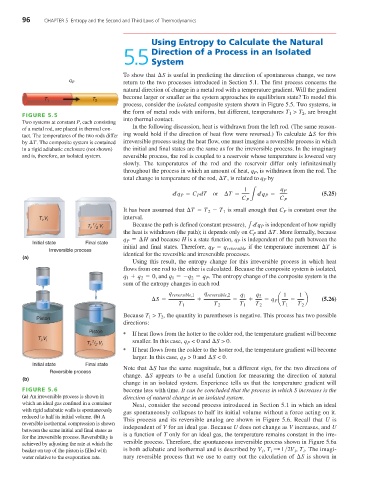
                                         process, consider the isolated composite system shown in Figure 5.5. Two systems, in
                                         the form of metal rods with uniform, but different, temperatures T > T , are brought
                                                                                               1
                                                                                                    2
        FIGURE 5.5
                                         into thermal contact.
        Two systems at constant P, each consisting
                                            In the following discussion, heat is withdrawn from the left rod. (The same reason-
        of a metal rod, are placed in thermal con-
                                         ing would hold if the direction of heat flow were reversed.) To calculate  ¢S  for this
        tact. The temperatures of the two rods differ
        by ¢T . The composite system is contained  irreversible process using the heat flow, one must imagine a reversible process in which
        in a rigid adiabatic enclosure (not shown)  the initial and final states are the same as for the irreversible process. In the imaginary
        and is, therefore, an isolated system.  reversible process, the rod is coupled to a reservoir whose temperature is lowered very
                                         slowly. The temperatures of the rod and the reservoir differ only infinitesimally
                                         throughout the process in which an amount of heat, q , is withdrawn from the rod. The
                                                                                    P
                                         total change in temperature of the rod, ¢T , is related to q by
                                                                                       P
                                                                                 1          q P
                                                         dq = C dT  or  ¢T =         dq =                 (5.25)
                                                                 P
                                                            P
                                                                                        P
                                                                                 P          C P
                                                                                C L
                                         It has been assumed that ¢T = T - T 1  is small enough that C P is constant over the
                                                                     2
              T ,V i                     interval.
               i
                               1
                             T , / V i      Because the path is defined (constant pressure),  dq P  is independent of how rapidly
                                2
                              i
                                                                                  1
                                         the heat is withdrawn (the path); it depends only on C P and ¢T . More formally, because
                                         q =¢H    and because H is a state function, q P is independent of the path between the
                                          P
            Initial state    Final state
                                         initial and final states. Therefore, q = q reversible  if the temperature increment  ¢T  is
                                                                      P
                 Irreversible process
                                         identical for the reversible and irreversible processes.
        (a)
                                            Using this result, the entropy change for this irreversible process in which heat
                                         flows from one rod to the other is calculated. Because the composite system is isolated,
                                         q + q = 0, and q =-q = q   P . The entropy change of the composite system is the
                                          1
                                               2
                                                               2
                                                         1
                                         sum of the entropy changes in each rod
                                                        q reversible,1  q reversible,2  q 1  q 2  1  1
                                                  ¢S =           +           =    +    = q a    -   b     (5.26)
                                                                                           P
                                                           T 1         T 2     T 1  T 2      T 1  T 2
                                         Because T 1 > T 2 , the quantity in parentheses is negative. This process has two possible
             Piston
                                         directions:
                              Piston     •  If heat flows from the hotter to the colder rod, the temperature gradient will become
             T ,V i
              i
                               1
                             T , / V i      smaller. In this case, q P  < 0 and ¢S  > 0.
                                2
                              i
                                         •  If heat flows from the colder to the hotter rod, the temperature gradient will become
                                            larger. In this case, q P  > 0 and ¢S  < 0.
            Initial state    Final state
                                         Note that  ¢S  has the same magnitude, but a different sign, for the two directions of
                 Reversible process
                                         change.  ¢S  appears to be a useful function for measuring the direction of natural
        (b)
                                         change in an isolated system. Experience tells us that the temperature gradient will
        FIGURE 5.6                       become less with time. It can be concluded that the process in which S increases is the
        (a) An irreversible process is shown in  direction of natural change in an isolated system.
        which an ideal gas confined in a container  Next, consider the second process introduced in Section 5.1 in which an ideal
        with rigid adiabatic walls is spontaneously  gas spontaneously collapses to half its initial volume without a force acting on it.
        reduced to half its initial volume. (b) A  This process and its reversible analog are shown in Figure 5.6. Recall that  U is
        reversible isothermal compression is shown
        between the same initial and final states as  independent of V for an ideal gas. Because U does not change as V increases, and U
        for the irreversible process. Reversibility is  is a function of T only for an ideal gas, the temperature remains constant in the irre-
        achieved by adjusting the rate at which the  versible process. Therefore, the spontaneous irreversible process shown in Figure 5.6a
        beaker on top of the piston is filled with  is both adiabatic and isothermal and is described by  , T : 1/2VV i  i  i ,  . The imagi-
                                                                                                   T i
        water relative to the evaporation rate.   nary reversible process that we use to carry out the calculation of  ¢S  is shown in

