


Page 122 - Physical chemistry eng
P. 122
99
                                               5.7 THE CHANGE OF ENTROPY IN THE SURROUNDINGS AND ¢S total =¢S +¢S surroundings
              between the system and the surroundings. Therefore, the surroundings always remain
              in internal equilibrium during heat transfer.
                 Next consider the entropy change of the surroundings, whereby the surroundings
              are at either constant V or constant P. We assume that the system and surroundings are
              at the same temperature. If this were not the case, heat would flow across the boundary
              until T is the same for system and surroundings, unless the system is surrounded by adi-
              abatic walls, in which case q surroundings  = 0. The amount of heat absorbed by the sur-
              roundings, q surroundings , depends on the process occurring in the system. If the
              surroundings are at constant V, q surroundings  =¢U surroundings , and if the surroundings
                                                    . Because H and U are state functions,
              are at constant P, q surroundings =¢H surroundings
              the amount of heat entering the surroundings is independent of the path; q is the same
              whether the transfer occurs reversibly or irreversibly. Therefore,

                                      dq surroundings
                        dS surroundings =         or for a macroscopic change,
                                           T
                                      q surroundings
                        ¢S surroundings =                                     (5.37)
                                           T
              Note that the heat that appears in Equation (5.37) is the actual heat transferred because
              the heat transferred to the surroundings is independent of the path as discussed earlier.
              By contrast, in calculating ¢S  for the system,  dq reversible  for a reversible process that
              connects the initial and final states of the system must be used, not the actual dq  for the
              process. It is essential to understand this reasoning in order to carry out calculations
              for ¢S  and ¢S surroundings .
                 This important difference is discussed in calculating the entropy change of the system
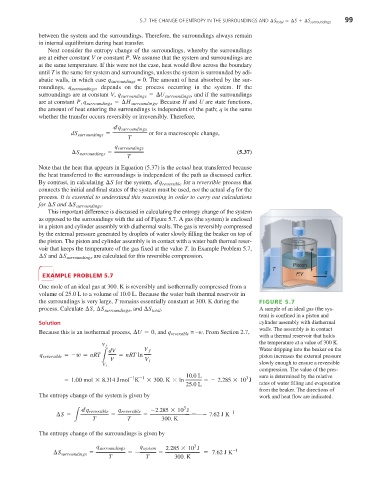
              as opposed to the surroundings with the aid of Figure 5.7. A gas (the system) is enclosed
              in a piston and cylinder assembly with diathermal walls. The gas is reversibly compressed
              by the external pressure generated by droplets of water slowly filling the beaker on top of
              the piston. The piston and cylinder assembly is in contact with a water bath thermal reser-
              voir that keeps the temperature of the gas fixed at the value T. In Example Problem 5.7,  w
              ¢S  and ¢S surroundings  are calculated for this reversible compression.
                                                                                                 Piston
                                                                                          T                q
               EXAMPLE PROBLEM 5.7                                                                P,V
              One mole of an ideal gas at 300. K is reversibly and isothermally compressed from a
              volume of 25.0 L to a volume of 10.0 L. Because the water bath thermal reservoir in
              the surroundings is very large, T remains essentially constant at 300. K during the  FIGURE 5.7
              process. Calculate ¢S , ¢S surroundings , and ¢S total .                A sample of an ideal gas (the sys-
                                                                                      tem) is confined in a piston and
              Solution                                                                cylinder assembly with diathermal
                                                                                      walls. The assembly is in contact
              Because this is an isothermal process, ¢U = 0 , and q reversible  = –w. From Section 2.7,
                                                                                      with a thermal reservoir that holds
                                                                                      the temperature at a value of 300 K.
                                  V f
                                    dV          V f                                   Water dripping into the beaker on the
               q reversible  =-w = nRT  = nRT ln                                      piston increases the external pressure
                                     V          V i
                                  3                                                   slowly enough to ensure a reversible
                                  V i
                                                                                      compression. The value of the pres-
                                                              10.0 L             3    sure is determined by the relative
                                           -1 -1
                       = 1.00 mol * 8.314 Jmol K  * 300. K * ln     =- 2.285 * 10 J
                                                              25.0 L                  rates of water filling and evaporation
                                                                                      from the beaker. The directions of
              The entropy change of the system is given by                            work and heat flow are indicated.
                                                             3
                            dq reversible  q reversible  -2.285 * 10 J
                   ¢S =              =          =               =   - 7.62 J K -1
                               T           T          300. K
                         L
              The entropy change of the surroundings is given by
                                                                3
                                q surroundings  q system  2.285 * 10 J
                  ¢S surroundings  =       =-        =              =  7.62 J K -1
                                     T           T        300. K

