


Page 342 - Physical Chemistry
P. 342
lev38627_ch10.qxd  3/14/08  1:07 PM  Page 323


                                                                                                                 323
                      The integral in (10.104) can be evaluated from measured values of V versus P          Section 10.10
                                                                                 m
                  (Prob. 10.64) or from an equation of state. Use of the virial equation (8.5) in (10.104)  Nonideal Gas Mixtures
                  gives the simple result (Prob. 10.60)
                                          †
                                                    †
                                                  1
                                                             1
                                                                    3
                                                               †
                                                         2
                                  ln f   B 1T 2P   C 1T 2P   D 1T 2P     p         (10.105)
                                                  2          3
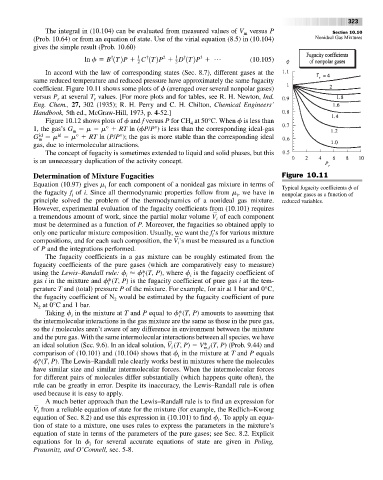
                      In accord with the law of corresponding states (Sec. 8.7), different gases at the
                  same reduced temperature and reduced pressure have approximately the same fugacity
                  coefficient. Figure 10.11 shows some plots of f (averaged over several nonpolar gases)
                  versus P at several T values. [For more plots and for tables, see R. H. Newton, Ind.
                                     r
                          r
                  Eng. Chem., 27, 302 (1935); R. H. Perry and C. H. Chilton,  Chemical Engineers’
                  Handbook, 5th ed., McGraw-Hill, 1973, p. 4-52.]
                      Figure 10.12 shows plots of f and f versus P for CH at 50°C. When f is less than
                                                                 4
                  1, the gas’s G   m   m°   RT ln (fP/P°) is less than the corresponding ideal-gas
                              m
                          id
                    id
                  G   m   m°   RT ln (P/P°); the gas is more stable than the corresponding ideal
                    m
                  gas, due to intermolecular attractions.
                      The concept of fugacity is sometimes extended to liquid and solid phases, but this
                  is an unnecessary duplication of the activity concept.
                  Determination of Mixture Fugacities                                        Figure 10.11
                  Equation (10.97) gives m for each component of a nonideal gas mixture in terms of  Typical fugacity coefficients f of
                                        i
                  the fugacity f of i. Since all thermodynamic properties follow from m , we have in  nonpolar gases as a function of
                              i
                                                                               i
                  principle solved the problem of the thermodynamics of a nonideal gas mixture.  reduced variables.
                  However, experimental evaluation of the fugacity coefficients from (10.101) requires

                  a tremendous amount of work, since the partial molar volume V i  of each component
                  must be determined as a function of P. Moreover, the fugacities so obtained apply to
                  only one particular mixture composition. Usually, we want the f ’s for various mixture
                                                                        i

                  compositions, and for each such composition, the V ’s  must be measured as a function
                                                              i
                  of P and the integrations performed.
                      The fugacity coefficients in a gas mixture can be roughly estimated from the
                  fugacity coefficients of the pure gases (which are comparatively easy to measure)
                  using the Lewis–Randall rule: f   f*(T, P), where f is the fugacity coefficient of
                                                   i
                                              i
                                                                 i
                  gas i in the mixture and f*(T, P) is the fugacity coefficient of pure gas i at the tem-
                                         i
                  perature T and (total) pressure P of the mixture. For example, for air at 1 bar and 0°C,
                  the fugacity coefficient of N would be estimated by the fugacity coefficient of pure
                                           2
                  N at 0°C and 1 bar.
                    2
                      Taking f in the mixture at T and P equal to f*(T, P) amounts to assuming that
                              i
                                                              i
                  the intermolecular interactions in the gas mixture are the same as those in the pure gas,
                  so the i molecules aren’t aware of any difference in environment between the mixture
                  and the pure gas. With the same intermolecular interactions between all species, we have

                  an ideal solution (Sec. 9.6). In an ideal solution, V i (T, P)   V* (T, P) (Prob. 9.44) and
                                                                     m,i
                  comparison of (10.101) and (10.104) shows that f in the mixture at T and P equals
                                                              i
                  f*(T, P). The Lewis–Randall rule clearly works best in mixtures where the molecules
                    i
                  have similar size and similar intermolecular forces. When the intermolecular forces
                  for different pairs of molecules differ substantially (which happens quite often), the
                  rule can be greatly in error. Despite its inaccuracy, the Lewis–Randall rule is often
                  used because it is easy to apply.
                      A much better approach than the Lewis–Randall rule is to find an expression for

                  V i  from a reliable equation of state for the mixture (for example, the Redlich–Kwong
                  equation of Sec. 8.2) and use this expression in (10.101) to find f . To apply an equa-
                                                                          i
                  tion of state to a mixture, one uses rules to express the parameters in the mixture’s
                  equation of state in terms of the parameters of the pure gases; see Sec. 8.2. Explicit
                  equations for ln  f for several accurate equations of state are given in  Poling,
                                   i
                  Prausnitz, and O’Connell, sec. 5-8.

