


Page 394 - Physical Chemistry
P. 394
lev38627_ch12.qxd  3/18/08  2:41 PM  Page 375


                                                                                                                 375
                  mixture that has the eutectic composition will melt entirely at one temperature (T ).      Section 12.8
                                                                                        3
                                                                                                           Two-Component
                  A solution of B and C that has the eutectic composition will freeze entirely at tem-  Solid–Liquid Equilibrium
                  perature T to produce a eutectic mixture of solids B and C. However, a eutectic mix-
                           3
                  ture is not a compound. Microscopic examination will show the eutectic solid to be an
                  intimate mixture of crystals of B and crystals of C.
                      Systems with the solid–liquid phase diagram of Fig. 12.19 are called  simple
                  eutectic systems. Examples include Pb–Sb, benzene–naphthalene, Si–Al, KCl–AgCl,
                  Bi–Cd, C H –CH Cl, and chloroform–aniline.
                             6
                          6
                                 3
                  Solid Solutions
                  Certain pairs of substances form solid solutions. In a solid solution of B and C, there
                  are no individual crystals of B or C. Instead, the molecules or atoms or ions are mixed
                  together at the molecular level, and the composition of the solution can be varied con-
                  tinuously over a certain range. Solid solutions can be prepared by condensing a vapor
                  of B plus C or by cooling a liquid solution of B and C. Two solids might be completely
                  miscible, partly miscible, or completely immiscible.
                      In an interstitial solid solution, the B molecules or atoms (which must be small)
                  occupy interstices (holes) in the crystal structure of substance C. For example, steel is
                  a solution in which carbon atoms occupy interstices in the Fe crystal structure. In a
                  substitutional solid solution, molecules or atoms or ions of B substitute for those of C
                  at random locations in the crystal structure. Examples include Cu–Ni, Na CO –
                                                                                     2
                                                                                         3
                  K CO , and p-dichlorobenzene–p-dibromobenzene. Substitutional solids are formed
                    2
                        3
                  by substances with atoms, molecules, or ions of similar size and structure.
                      Analysis of a transition-metal oxide or sulfide frequently shows an apparent vio-
                  lation of the law of definite proportions. For example, ZnO usually has a Zn/O mole
                  ratio slightly greater than 1. The explanation is that the “zinc oxide” is actually an
                  interstitial solid solution of Zn in ZnO.
                  Liquid-Phase Miscibility and Solid-Phase Miscibility
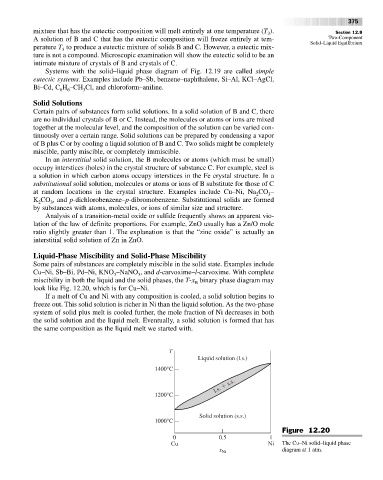
                  Some pairs of substances are completely miscible in the solid state. Examples include
                  Cu–Ni, Sb–Bi, Pd–Ni, KNO –NaNO , and d-carvoxime–l-carvoxime. With complete
                                           3
                                                  3
                  miscibility in both the liquid and the solid phases, the T-x binary phase diagram may
                                                                   B
                  look like Fig. 12.20, which is for Cu–Ni.
                      If a melt of Cu and Ni with any composition is cooled, a solid solution begins to
                  freeze out. This solid solution is richer in Ni than the liquid solution. As the two-phase
                  system of solid plus melt is cooled further, the mole fraction of Ni decreases in both
                  the solid solution and the liquid melt. Eventually, a solid solution is formed that has
                  the same composition as the liquid melt we started with.


                                                           T
                                                                    Liquid solution (l.s.)
                                                       1400°C
                                                                         l.s.   s.s.

                                                       1200°C


                                                                    Solid solution (s.s.)
                                                       1000°C
                                                                                             Figure 12.20
                                                            0             0.5            1
                                                            Cu                           Ni  The Cu–Ni solid–liquid phase
                                                                                             diagram at 1 atm.
                                                                          x Ni

