


Page 389 - Physical Chemistry
P. 389
lev38627_ch12.qxd  3/18/08  2:41 PM  Page 370


                370
               Chapter 12                of this chapter. All points between J and K on the tie line correspond to states with the
                                                                    b
                                                      a
               Multicomponent Phase Equilibrium  same value of x and the same x .
                                                      B
                                                                    B
                                          12.7          TWO-COMPONENT LIQUID–LIQUID EQUILIBRIUM
                                         When any amounts of ethanol and water are shaken together in a separatory funnel at
                                         room temperature, one always obtains a single-phase liquid system. Ethanol and water
                                         are soluble in each other to unlimited extents and are said to be completely miscible.
                                         When roughly equal amounts of 1-butanol and water are shaken together at room tem-
                                         perature, one obtains a system consisting of two liquid phases: one phase is water con-
                                         taining a small amount of dissolved 1-butanol, and the other is 1-butanol containing a
                                         small amount of dissolved water. These two liquids are partially miscible, meaning
                                         that each is soluble in the other to a limited extent.
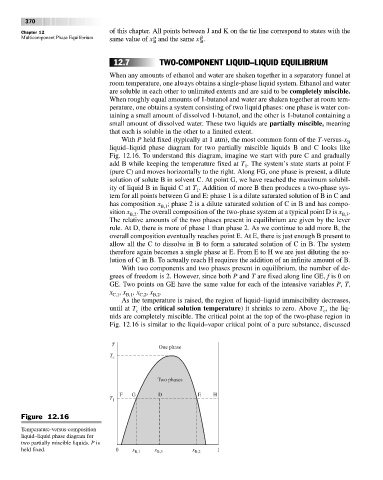
                                             With P held fixed (typically at 1 atm), the most common form of the T-versus-x B
                                         liquid–liquid phase diagram for two partially miscible liquids B and C looks like
                                         Fig. 12.16. To understand this diagram, imagine we start with pure C and gradually
                                         add B while keeping the temperature fixed at T . The system’s state starts at point F
                                                                                  1
                                         (pure C) and moves horizontally to the right. Along FG, one phase is present, a dilute
                                         solution of solute B in solvent C. At point G, we have reached the maximum solubil-
                                         ity of liquid B in liquid C at T . Addition of more B then produces a two-phase sys-
                                                                   1
                                         tem for all points between G and E: phase 1 is a dilute saturated solution of B in C and
                                         has composition x ; phase 2 is a dilute saturated solution of C in B and has compo-
                                                         B,1
                                         sition x . The overall composition of the two-phase system at a typical point D is x .
                                                                                                               B,3
                                               B,2
                                         The relative amounts of the two phases present in equilibrium are given by the lever
                                         rule. At D, there is more of phase 1 than phase 2. As we continue to add more B, the
                                         overall composition eventually reaches point E. At E, there is just enough B present to
                                         allow all the C to dissolve in B to form a saturated solution of C in B. The system
                                         therefore again becomes a single phase at E. From E to H we are just diluting the so-
                                         lution of C in B. To actually reach H requires the addition of an infinite amount of B.
                                             With two components and two phases present in equilibrium, the number of de-
                                         grees of freedom is 2. However, since both P and T are fixed along line GE, f is 0 on
                                         GE. Two points on GE have the same value for each of the intensive variables P, T,
                                         x , x , x , x .
                                              B,1
                                                  C,2
                                          C,1
                                                      B,2
                                             As the temperature is raised, the region of liquid–liquid immiscibility decreases,
                                         until at T (the critical solution temperature)it shrinks to zero. Above T , the liq-
                                                                                                         c
                                                 c
                                         uids are completely miscible. The critical point at the top of the two-phase region in
                                         Fig. 12.16 is similar to the liquid–vapor critical point of a pure substance, discussed
                                          T
                                                        One phase
                                         T c

                                                        Two phases

                                            F   G       D           E   H
                                         T 1

               Figure 12.16
               Temperature-versus-composition
               liquid–liquid phase diagram for
               two partially miscible liquids. P is
               held fixed.                 0    x B,1  x B,3      x B,2  1

