


Page 386 - Physical Chemistry
P. 386
lev38627_ch12.qxd  3/18/08  2:41 PM  Page 367


                                                                                                                 367
                  Ideal Solution at Fixed Pressure                                                           Section 12.6
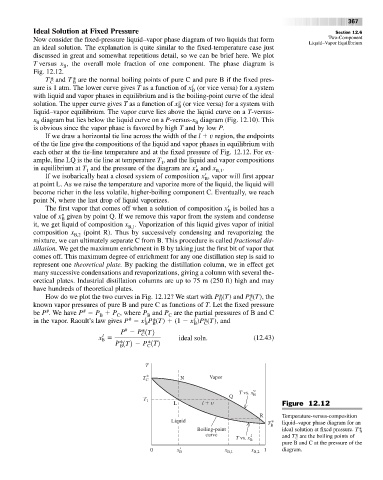
                  Now consider the fixed-pressure liquid–vapor phase diagram of two liquids that form      Two-Component
                                                                                                     Liquid–Vapor Equilibrium
                  an ideal solution. The explanation is quite similar to the fixed-temperature case just
                  discussed in great and somewhat repetitious detail, so we can be brief here. We plot
                  T versus  x , the overall mole fraction of one component. The phase diagram is
                           B
                  Fig. 12.12.
                      T * and T * are the normal boiling points of pure C and pure B if the fixed pres-
                       C      B
                                                                  l
                  sure is 1 atm. The lower curve gives T as a function of x (or vice versa) for a system
                                                                  B
                  with liquid and vapor phases in equilibrium and is the boiling-point curve of the ideal
                                                              v
                  solution. The upper curve gives T as a function of x (or vice versa) for a system with
                                                              B
                  liquid–vapor equilibrium. The vapor curve lies above the liquid curve on a T-versus-
                  x diagram but lies below the liquid curve on a P-versus-x diagram (Fig. 12.10). This
                   B                                               B
                  is obvious since the vapor phase is favored by high T and by low P.
                      If we draw a horizontal tie line across the width of the l   v region, the endpoints
                  of the tie line give the compositions of the liquid and vapor phases in equilibrium with
                  each other at the tie-line temperature and at the fixed pressure of Fig. 12.12. For ex-
                  ample, line LQ is the tie line at temperature T , and the liquid and vapor compositions
                                                         1
                  in equilibrium at T and the pressure of the diagram are x
 and x .
                                  1                                B     B,1
                      If we isobarically heat a closed system of composition x
, vapor will first appear
                                                                      B
                  at point L. As we raise the temperature and vaporize more of the liquid, the liquid will
                  become richer in the less volatile, higher-boiling component C. Eventually, we reach
                  point N, where the last drop of liquid vaporizes.
                      The first vapor that comes off when a solution of composition x
 is boiled has a
                                                                             B
                           v
                  value of x given by point Q. If we remove this vapor from the system and condense
                           B
                  it, we get liquid of composition x . Vaporization of this liquid gives vapor of initial
                                               B,1
                  composition  x  (point R). Thus by successively condensing and revaporizing the
                               B,2
                  mixture, we can ultimately separate C from B. This procedure is called fractional dis-
                  tillation. We get the maximum enrichment in B by taking just the first bit of vapor that
                  comes off. This maximum degree of enrichment for any one distillation step is said to
                  represent one theoretical plate. By packing the distillation column, we in effect get
                  many successive condensations and revaporizations, giving a column with several the-
                  oretical plates. Industrial distillation columns are up to 75 m (250 ft) high and may
                  have hundreds of theoretical plates.
                      How do we plot the two curves in Fig. 12.12? We start with P*(T) and P*(T), the
                                                                          B        C
                  known vapor pressures of pure B and pure C as functions of T. Let the fixed pressure
                      #
                                 #
                  be P . We have P   P   P , where P and P are the partial pressures of B and C
                                      B    C        B      C
                                                    l
                                               #
                                                                   l
                  in the vapor. Raoult’s law gives P   x P*(T)   (1   x )P*(T), and
                                                    B  B          B  C
                                              #
                                             P   P*1T2
                                                   C
                                      x                     ideal soln.             (12.43)
                                       l
                                       B
                                           P*1T2   P*1T2
                                                    C
                                            B
                                                    T
                                                   T *        N        Vapor
                                                    C

                                                                                T vs. x
                                                                             Q      B
                                                   T 1
                                                            L        l                       Figure 12.12
                                                                                      R      Temperature-versus-composition
                                                            Liquid                       T *  liquid–vapor phase diagram for an
                                                                   Boiling-point         B   ideal solution at fixed pressure. T* B
                                                                      curve        l         and T* are the boiling points of
                                                                               T vs. x           C
                                                                                   B
                                                                                             pure B and C at the pressure of the
                                                     0       x B ′          x B,1   x B,2  1  diagram.

