Page 381 - Physical Chemistry
P. 381

lev38627_ch12.qxd  3/18/08  2:41 PM  Page 362


                362
               Chapter 12                to heat and chemicals. Some examples of ceramics are sand, porcelain, cement, glass,
               Multicomponent Phase Equilibrium  bricks, diamond, SiC, Si N , Al O , MgO, and MgSiO ; many ceramics are silicates.
                                                                      3
                                                              3
                                                                                        4
                                                                    2
                                                                4
                                         A composite material is made of two or more materials and may possess properties
                                         not present in any one component. Bone is a composite of the soft, strong, polymeric
                                         protein collagen and the hard, brittle mineral hydroxyapatite [approximate formula
                                         3Ca (PO )   Ca(OH) ]. Fiberglass is a composite containing a plastic strengthened by
                                                 4 2
                                                           2
                                             3
                                         the addition of glass fibers.
                                          12.6          TWO-COMPONENT LIQUID–VAPOR EQUILIBRIUM
                                         Instead of plotting complete phase diagrams, we shall usually consider only one por-
                                         tion of the phase diagram at a time. This section deals with the liquid–vapor part of
                                         the phase diagram of a two-component system, which is important in laboratory and
                                         industrial separations of liquids by distillation.

                                         Ideal Solution at Fixed Temperature
                                         Consider two liquids B and C that form an ideal solution. We hold the temperature
                                         fixed at some value T that is above the freezing points of B and C. We shall plot the
                                         system’s pressure P against x , the overall mole fraction of B in the system:
                                                                  B
                                                                                 l
                                                                   n B,total    n   n v B
                                                                                 B
                                                              x                                            (12.34)
                                                               B
                                                                                 v
                                                                            l
                                                                                      l
                                                                    n total  n   n   n   n v C
                                                                                 B
                                                                                      C
                                                                            B
                                                        v
                                                 l
                                         where  n and  n are the number of moles of B in the liquid and vapor phases,
                                                B
                                                        B
                                                                                         l
                                                                                               v
                                         respectively. For a closed system x is fixed, although n and n may vary.
                                                                      B
                                                                                        B
                                                                                               B
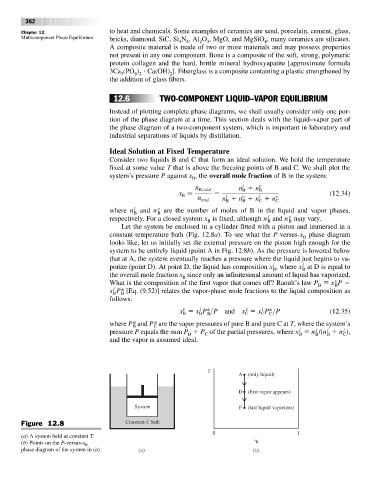
                                             Let the system be enclosed in a cylinder fitted with a piston and immersed in a
                                         constant-temperature bath (Fig. 12.8a). To see what the P-versus-x phase diagram
                                                                                                   B
                                         looks like, let us initially set the external pressure on the piston high enough for the
                                         system to be entirely liquid (point A in Fig. 12.8b). As the pressure is lowered below
                                         that at A, the system eventually reaches a pressure where the liquid just begins to va-
                                                                                          l
                                                                                                   l
                                         porize (point D). At point D, the liquid has composition x , where x at D is equal to
                                                                                          B
                                                                                                   B
                                         the overall mole fraction x since only an infinitesimal amount of liquid has vaporized.
                                                               B
                                                                                                             v
                                         What is the composition of the first vapor that comes off? Raoult’s law P   x P
                                                                                                             B
                                                                                                        B
                                          l
                                         x P* [Eq. (9.52)] relates the vapor-phase mole fractions to the liquid composition as
                                          B
                                             B
                                         follows:
                                                                                       l
                                                                                  v
                                                                    l
                                                               v
                                                              x   x P*>P  and  x   x P*>P                  (12.35)
                                                                                  C
                                                                                       C
                                                               B
                                                                    B
                                                                      B
                                                                                         C
                                         where P* and P* are the vapor pressures of pure B and pure C at T, where the system’s
                                                B
                                                      C
                                                                                                  l
                                                                                                               l
                                                                                                          l
                                                                                                       l
                                         pressure P equals the sum P   P of the partial pressures, where x   n /(n   n ),
                                                                                                  B
                                                                                                          B
                                                                 B
                                                                      C
                                                                                                       B
                                                                                                               C
                                         and the vapor is assumed ideal.
                                                                       P
                                                                                A (only liquid)
                                                                                D (first vapor appears)
                                                 System                         F  (last liquid vaporizes)
               Figure 12.8                    Constant-T bath
                                                                        0                        1
               (a) A system held at constant T.
               (b) Points on the P-versus-x B                                       x B
               phase diagram of the system in (a).  (a)                             (b)
   376   377   378   379   380   381   382   383   384   385   386