


Page 379 - Physical Chemistry
P. 379
lev38627_ch12.qxd  3/18/08  2:41 PM  Page 360


                360
               Chapter 12                Hence in place of ß   c RT [Eq. (12.27)], we get
                                                              B
               Multicomponent Phase Equilibrium
                                                                        RT
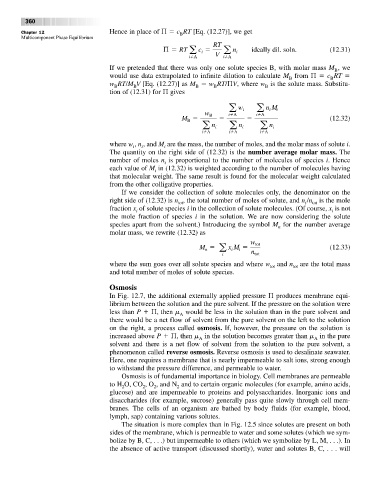
                                                         ß   RT  a  c      a  n    ideally dil. soln.      (12.31)
                                                                               i
                                                                     i
                                                                 i A     V  i A
                                         If we pretended that there was only one solute species B, with molar mass M , we
                                                                                                            B
                                         would use data extrapolated to infinite dilution to calculate M from ß   c RT
                                                                                                           B
                                                                                               B
                                         w RT/M V [Eq. (12.27)] as M   w RT/ßV, where w is the solute mass. Substitu-
                                                B
                                           B
                                                                   B
                                                                        B
                                                                                        B
                                         tion of (12.31) for ß gives
                                                                             a  w i  a  n M i
                                                                                         i
                                                                      w B    i A     i A
                                                               M                                           (12.32)
                                                                B
                                                                     a  n i  a  n i   a  n i
                                                                     i A     i A      i A
                                         where w , n , and M are the mass, the number of moles, and the molar mass of solute i.
                                                   i
                                                i
                                                          i
                                         The quantity on the right side of (12.32) is the number average molar mass. The
                                         number of moles n is proportional to the number of molecules of species i. Hence
                                                          i
                                         each value of M in (12.32) is weighted according to the number of molecules having
                                                       i
                                         that molecular weight. The same result is found for the molecular weight calculated
                                         from the other colligative properties.
                                             If we consider the collection of solute molecules only, the denominator on the
                                         right side of (12.32) is n , the total number of moles of solute, and n /n is the mole
                                                              tot
                                                                                                    i
                                                                                                      tot
                                         fraction x of solute species i in the collection of solute molecules. (Of course, x is not
                                                 i
                                                                                                            i
                                         the mole fraction of species  i in the solution. We are now considering the solute
                                         species apart from the solvent.) Introducing the symbol M for the number average
                                                                                            n
                                         molar mass, we rewrite (12.32) as
                                                                                   w tot
                                                                    M     a  x M                           (12.33)
                                                                                i
                                                                      n
                                                                              i
                                                                           i        n tot
                                         where the sum goes over all solute species and where w  and n  are the total mass
                                                                                         tot    tot
                                         and total number of moles of solute species.
                                         Osmosis
                                         In Fig. 12.7, the additional externally applied pressure ß produces membrane equi-
                                         librium between the solution and the pure solvent. If the pressure on the solution were
                                         less than P   ß, then m would be less in the solution than in the pure solvent and
                                                              A
                                         there would be a net flow of solvent from the pure solvent on the left to the solution
                                         on the right, a process called osmosis. If, however, the pressure on the solution is
                                         increased above P   ß, then m in the solution becomes greater than m in the pure
                                                                    A                                 A
                                         solvent and there is a net flow of solvent from the solution to the pure solvent, a
                                         phenomenon called reverse osmosis. Reverse osmosis is used to desalinate seawater.
                                         Here, one requires a membrane that is nearly impermeable to salt ions, strong enough
                                         to withstand the pressure difference, and permeable to water.
                                             Osmosis is of fundamental importance in biology. Cell membranes are permeable
                                         to H O, CO , O , and N and to certain organic molecules (for example, amino acids,
                                             2     2  2      2
                                         glucose) and are impermeable to proteins and polysaccharides. Inorganic ions and
                                         disaccharides (for example, sucrose) generally pass quite slowly through cell mem-
                                         branes. The cells of an organism are bathed by body fluids (for example, blood,
                                         lymph, sap) containing various solutes.
                                             The situation is more complex than in Fig. 12.5 since solutes are present on both
                                         sides of the membrane, which is permeable to water and some solutes (which we sym-
                                         bolize by B, C, . . .) but impermeable to others (which we symbolize by L, M, . . .). In
                                         the absence of active transport (discussed shortly), water and solutes B, C, . . . will

