


Page 100 - Piston Engine-Based Power Plants
P. 100
The Economics of Piston Engine Power Plants  91


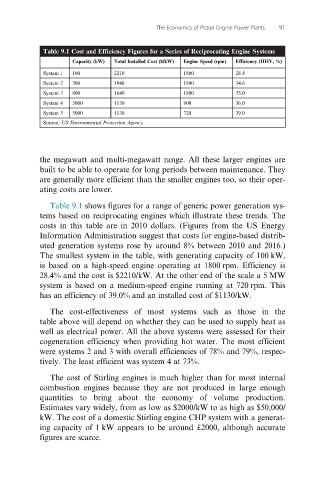
             Table 9.1 Cost and Efficiency Figures for a Series of Reciprocating Engine Systems
                     Capacity (kW)  Total Installed Cost ($/kW)  Engine Speed (rpm)  Efficiency (HHV, %)
             System 1  100      2210               1800          28.4
             System 2  300      1940               1800          34.6
             System 3  800      1640               1800          35.0
             System 4  3000     1130               900           36.0
             System 5  5000     1130               720           39.0
             Source: US Environmental Protection Agency.


            the megawatt and multi-megawatt range. All these larger engines are
            built to be able to operate for long periods between maintenance. They
            are generally more efficient than the smaller engines too, so their oper-
            ating costs are lower.

               Table 9.1 shows figures for a range of generic power generation sys-
            tems based on reciprocating engines which illustrate these trends. The
            costs in this table are in 2010 dollars. (Figures from the US Energy
            Information Administration suggest that costs for engine-based distrib-
            uted generation systems rose by around 8% between 2010 and 2016.)
            The smallest system in the table, with generating capacity of 100 kW,
            is based on a high-speed engine operating at 1800 rpm. Efficiency is
            28.4% and the cost is $2210/kW. At the other end of the scale a 5 MW
            system is based on a medium-speed engine running at 720 rpm. This
            has an efficiency of 39.0% and an installed cost of $1130/kW.

               The cost-effectiveness of most systems such as those in the
            table above will depend on whether they can be used to supply heat as
            well as electrical power. All the above systems were assessed for their
            cogeneration efficiency when providing hot water. The most efficient
            were systems 2 and 3 with overall efficiencies of 78% and 79%, respec-
            tively. The least efficient was system 4 at 73%.

               The cost of Stirling engines is much higher than for most internal
            combustion engines because they are not produced in large enough
            quantities to bring about the economy of volume production.
            Estimates vary widely, from as low as $2000/kW to as high as $50,000/
            kW. The cost of a domestic Stirling engine CHP system with a generat-
            ing capacity of 1 kW appears to be around d2000, although accurate
            figures are scarce.

