


Page 378 - Planning and Design of Airports
P. 378
Airport Lighting, Marking, and Signage     329


                                                           6–12''
                                                   9'(2.74 m)
                                                           (15–30 cm)
                          See Notes 1 and 2
                                                   3' (.91 m)
              3'' (7.62 cm)

                                                           150' (45.72 m)


                 6'' (15.24 cm)  6'' (15.24 cm)


                                   6' (1.83 m)
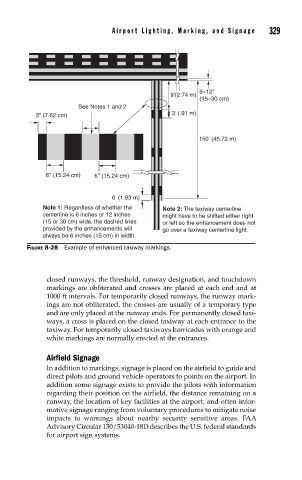
                Note 1: Regardless of whether the  Note 2: The taxiway centerline
                centerline is 6 inches or 12 inches  might have to be shifted either right
                (15 or 30 cm) wide, the dashed lines  or left so the enhancement does not
                provided by the enhancements will  go over a taxiway centerline light.
                always be 6 inches (15 cm) in width.
            FIGURE 8-28  Example of enhanced taxiway markings.


                 closed runways, the threshold, runway designation, and touchdown
                 markings are obliterated and crosses are placed at each end and at
                 1000 ft intervals. For temporarily closed runways, the runway mark-
                 ings are not obliterated, the crosses are usually of a temporary type
                 and are only placed at the runway ends. For permanently closed taxi-
                 ways, a cross is placed on the closed taxiway at each entrance to the
                 taxiway. For temporarily closed taxiways barricades with orange and
                 white markings are normally erected at the entrances.

                 Airfield Signage
                 In addition to markings, signage is placed on the airfield to guide and
                 direct pilots and ground vehicle operators to points on the airport. In
                 addition some signage exists to provide the pilots with information
                 regarding their position on the airfield, the distance remaining on a
                 runway, the location of key facilities at the airport, and often infor-
                 mative signage ranging from voluntary procedures to mitigate noise
                 impacts to warnings about nearby security sensitive areas. FAA
                 Advisory Circular 150/53040-18D describes the U.S. federal standards
                 for airport sign systems.

