


Page 374 - Planning and Design of Airports
P. 374
326    Airp o r t  D e sign


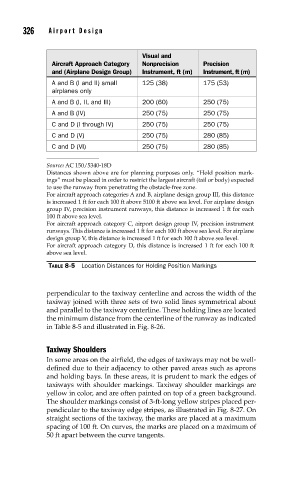
                                           Visual and
                  Aircraft Approach Category   Nonprecision   Precision
                  and (Airplane Design Group)  Instrument, ft (m)  Instrument, ft (m)
                  A and B (I and II) small   125 (38)       175 (53)
                  airplanes only
                  A and B (I, II, and III)  200 (60)        250 (75)
                  A and B (IV)             250 (75)         250 (75)
                  C and D (I through IV)   250 (75)         250 (75)
                  C and D (V)              250 (75)         280 (85)
                  C and D (VI)             250 (75)         280 (85)

                 Source: AC 150/5340-18D
                 Distances shown above are for planning purposes only. “Hold position mark-
                 ings” must be placed in order to restrict the largest aircraft (tail or body) expected
                 to use the runway from penetrating the obstacle-free zone.
                 For aircraft approach categories A and B, airplane design group III, this distance
                 is increased 1 ft for each 100 ft above 5100 ft above sea level. For airplane design
                 group IV, precision instrument runways, this distance is increased 1 ft for each
                 100 ft above sea level.
                 For aircraft approach category C, airport design group IV, precision instrument
                 runways. This distance is increased 1 ft for each 100 ft above sea level. For airplane
                 design group V, this distance is increased 1 ft for each 100 ft above sea level.
                 For aircraft approach category D, this distance is increased 1 ft for each 100 ft
                 above sea level.

                  TABLE 8-5  Location Distances for Holding Position Markings


                 perpendicular to the taxiway centerline and across the width of the
                 taxiway joined with three sets of two solid lines symmetrical about
                 and parallel to the taxiway centerline. These holding lines are located
                 the minimum distance from the centerline of the runway as indicated
                 in Table 8-5 and illustrated in Fig. 8-26.


                 Taxiway Shoulders
                 In some areas on the airfield, the edges of taxiways may not be well-
                 defined due to their adjacency to other paved areas such as aprons
                 and holding bays. In these areas, it is prudent to mark the edges of
                 taxiways with shoulder markings. Taxiway shoulder markings are
                 yellow in color, and are often painted on top of a green background.
                 The shoulder markings consist of 3-ft-long yellow stripes placed per-
                 pendicular to the taxiway edge stripes, as illustrated in Fig. 8-27. On
                 straight sections of the taxiway, the marks are placed at a maximum
                 spacing of 100 ft. On curves, the marks are placed on a maximum of
                 50 ft apart between the curve tangents.

