


Page 464 - Practical Design Ships and Floating Structures
P. 464
43 9


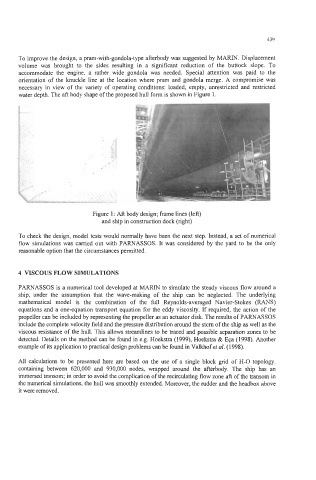
      To improve the design, a pram-with-gondola-type afterbody was suggested by MARIN. Displacement
      volume  was  brought  to  the  sides  resulting  in  a  significant  reduction  of  the  buttock  slope.  To
      accommodate  the  engine,  a  rather  wide  gondola  was  needed.  Special  attention  was  paid  to  the
      orientation  of the knuckle  line at the  location where  pram  and gondola merge.  A  compromise was
      necessary  in  view  of the  variety of  operating conditions:  loaded, empty, unrestricted  and  restricted
      water depth. The aft body shape of the proposed hull form is shown in Figure 1.


                            Figure 1 : Aft body design; fiame lines (left)
                               and ship in construction dock (right)

      To check the design, model tests would normally have been the next step. Instead, a set of numerical
      flow simulations was carried  out with  PARNASSOS.  It was considered by the yard  to be the  only
      reasonable option that the circumstances permitted.


      4  VISCOUS FLOW SIMULATIONS
      PARNASSOS is a numerical tool developed at MARIN to simulate the steady viscous flow around a
      ship,  under  the  assumption  that  the  wave-making  of  the  ship  can  be  neglected.  The  underlying
      mathematical  model  is  the  combination  of  the  full  Reynolds-averaged  Navier-Stokes  (RANS)
      equations and a one-equation  transport  equation for the eddy viscosity.  If required,  the action of the
      propeller can be included by representing the propeller as an actuator disk. The results of PARNASSOS
      include the complete velocity field and the pressure distribution around the stem of the ship as well as the
      viscous resistance of the hull. This allows streamlines to be traced and possible separation zones to be
      detected. Details on the method can be found in e.g. Hoekstra (1999), Hoekstra & @a  (1998). Another
      example of its application to practical design problems can be found in Valkhof et ul. (1 998).

      All  calculations to  be  presented  here  are based  on the  use of  a  single  block  grid  of  H-0 topology,
      containing  between  620,000  and  930,000  nodes,  wrapped  around  the  afterbody.  The  ship  has  an
      immersed transom; in order to avoid the complication of the recirculating flow zone aft of the transom in
      the numerical simulations, the hull was smoothly extended. Moreover, the rudder and the headbox above
      it were removed.

