


Page 467 - Practical Design Ships and Floating Structures
P. 467
442

            persisted and was brought closer to the propeller. So it was decided to reject the hull modification.
            Because there was no time left for further exercises the hull design was accepted as maybe not perfect
            but certainly good enough to guarantee an acceptable inflow to the propeller.


            5  PROPELLER DESIGN
            For the propeller design two sets of data concerning the wake field in loaded and empty condition were
            delivered by  the  PARNASSOS code:  the  wake  field  plots  of  axial,  radial and  tangential velocity
            components (as normally delivered after conduction of a wake field model test), and, in addition, the
            pressure distribution over the propeller plane. Because the nominal wake field for both the model scale
            and full scale situation was  provided, as well  as the flow field with active propeller, the propeller
            designer got in fact more information than usual. He assessed the wake fields as "quite normal", which
            ensured the yard that the job was well done for this single-screw full-block aft body.

            After completion of  the  propeller design, the  propeller manufacturer informed the  yard  about the
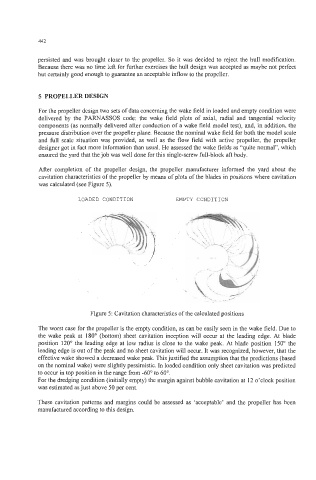
            cavitation characteristics of the propeller by means of plots of the blades in positions where cavitation
            was calculated (see Figure 5).
                        LOADED CONDITION            EMPTY CONDITION


                           Figure 5: Cavitation characteristics of the calculated positions

            The worst case for the propeller is the empty condition, as can be easily seen in the wake field. Due to
            the wake peak at  180" (bottom) sheet cavitation inception will occur at the leading edge. At blade
            position  120" the  leading edge at low radius is close to the wake peak. At  blade position  150" the
            leading edge is out of the peak and no sheet cavitation will occur. It was recognized, however, that the
            effective wake showed a decreased wake peak. This justified the assumption that the predictions (based
            on the nominal wake) were slightly pessimistic. In loaded condition only sheet cavitation was predicted
            to occur in top position in the range from -60" to 60".
            For the dredging condition (initially empty) the margin against bubble cavitation at 12 o'clock position
            was estimated as just above 50 per cent.

            These cavitation patterns and margins could be  assessed as 'acceptable'  and the propeller has been
            manufactured according to this design.

