


Page 465 - Practical Design Ships and Floating Structures
P. 465
440

            The following series of calculations was carried out for the new design:
                         Draught condition    Reynolds number       Propeller
                            loaded           7.96*  10  (model scale)   no
                            loaded           3.73*10  (full scale)      no
                            loaded           7.96* 10  (model scale)    Yes
                            empty            8.68* 10  (model scale)    no
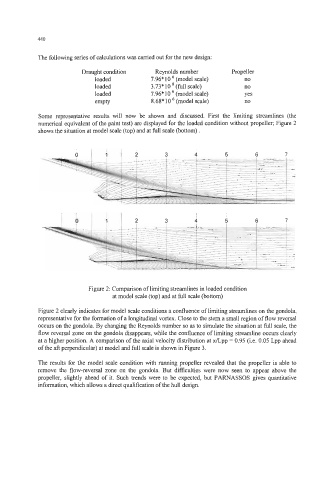
            Some  representative  results  will  now  be  shown  and  discussed. First  the  limiting  streamlines (the
            numerical equivalent of the paint test) are displayed for the loaded condition without propeller; Figure 2
            shows the situation at model scale (top) and at full scale (bottom) .


                                                          I       I        I
                                                 3       4        5        6       7


                           Figure 2: Comparison of limiting streamlines in loaded condition
                                 at model scale (top) and at full scale (bottom)
            Figure 2 clearly indicates for model scale conditions a confluence of limiting streamlines on the gondola,
            representative for the formation of a longitudinal vortex. Close to the stem a small region of flow reversal
            occurs on the gondola. By changing the Reynolds number so as to simulate the situation at full scale, the
            flow reversal zone on the gondola disappears, while the confluence of limiting streamline occurs clearly
            at a higher position. A comparison of the axial velocity distribution at x/Lpp = 0.95 (i.e. 0.05 Lpp ahead
            of the aft perpendicular) at model and full scale is shown in Figure 3.

            The results for the model scale condition with running propeller revealed that the propeller is able to
            remove the  flow-reversal zone on the  gondola. But  difficulties were now  seen to  appear above the
            propeller, slightly ahead of  it.  Such trends were to be  expected, but  PARNASSOS gives quantitative
            information, which allows a direct qualification of the hull design.

