


Page 285 - Practical Ship Design
P. 285
Design of  Lines                                                    243
                                            I
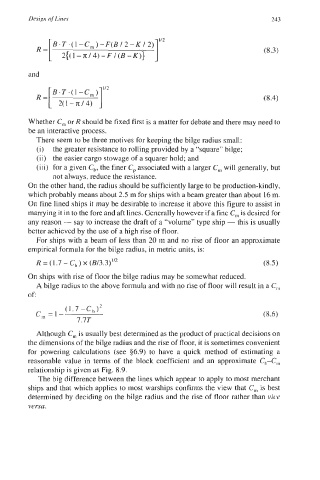
                B.T .(1 -C,)  -F(B / 2-K  / 2)
           R=[                                                             (8.3)
                  2{(  1 - .n / 4) - F / (B - K)}

         and

                B.T .(l-C,)   112
                                                                           (8.4)
                 2(1 -IT/ 4)
         Whether C,  or R should be fixed first is a matter for debate and there may need to
         be an interactive process.
           There seem to be three motives for keeping the bilge radius small:
           (i)  the greater resistance to rolling provided by a “square” bilge;
           (ii)  the easier cargo stowage of a squarer hold; and
           (iii)  for a given C,, the finer Cp associated with a larger C, will generally, but
                not always, reduce the resistance.
         On the other hand, the radius should be sufficiently large to be production-kindly,
         which probably means about 2.5 m for ships with a beam greater than about 16 m.
         On fine lined ships it may be desirable to increase it above this figure to assist in
         marrying it in to the fore and aft lines. Generally however if a fine C, is desired for
         any reason - say to increase the draft of a “volume” type ship - this is usually
         better achieved by the use of a high rise of floor.
           For ships with a beam of less than 20 m and no rise of floor an approximate
         empirical formula for the bilge radius, in metric units, is:
           R = (1.7 - C,,) x (B/3.3)”*                                     (8.5)

         On ships with rise of floor the bilge radius may be somewhat reduced.
           A bilge radius to the above formula and with no rise of floor will result in a C,
         Of
                   (1.7-C,)2
           c,, =I-
                       7.7T

           Although C, is usually best determined as the product of practical decisions on
         the dimensions of the bilge radius and the rise of floor, it is sometimes convenient
         for  powering  calculations  (see  $6.9) to  have  a  quick  method  of  estimating  a
         reasonable  value  in  terms  of  the  block  coefficient and  an  approximate C,,-C,,
         relationship is given as Fig. 8.9.
            The big difference between the lines which appear to apply to most merchant
         ships and that which applies to most warships confirms the view that C,  is best
         determined by  deciding on the bilge radius and the rise of floor rather than vice
         versa.

