


Page 180 - Pressure Vessel Design Manual
P. 180
158    Pressure Vessel Design Manual

                                                               Note: P.O.V. may be determined from chart in Figure 3-9. H
                                                               and D are in feet; t is in inches.

                                                                   V = Ct,W,  (from Procedure 3-3)
                                                                  Ft = 0.07TV    or    0.25V
                                                                    whichever is less

                                                               Note: If H/D p 3 or T p 0.7 sec, then Ft = 0


                                                                  Mi, = FtH + %(FH)
                                                               Moment at any height hi


                                                               Case 2: Nonuniform Vessels

                                                               Procedure €or finding period of vibration, moments,
                                                               and forces at various planes for nonuniform vessels.
                                                               A “nonuniform” vertical vessel is one that vanes in diameter,
                                                               thickness,  or weight  at different elevations. This procedure
                                                               distributes the seismic forces and thus base shear, along the
                                                               column  in  proportion  to  the  weights  of  each  section.  The
                                                               results  are  a  more  accurate  and  realistic  distribution  of
                                                               forces and accordingly a more accurate period  of vibration.
                                                               The procedure  consists of two main steps:
                                                 V
                                                                Step  1: Determination  of  period  of  vibration  (P.O.V.), T.
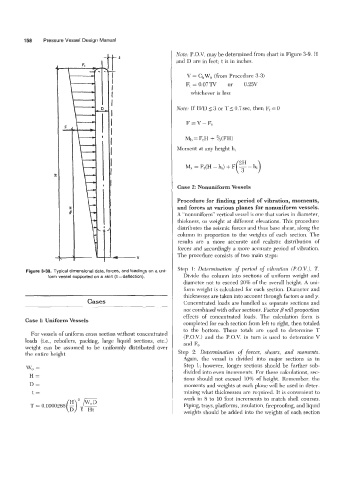
          Figure 3-38.  Typical dimensional data, forces, and loadings on a uni-
                  form vessel supported on a skirt (8 =deflection).   Divide  the  column  into  sections  of uniform  weight  and
                                                                  diameter not to exceed 20% of the overall height. A uni-
                                                                  form weight is calculated  for each section. Diameter  and
                                                                  thicknesses are taken into account through factors a! and y.
                                Cases                             Concentrated loads  are handled  as separate  sections and
                                                                  not combined with other sections. Factor B will proportion
                                                                  effects  of  concentrated  loads.  The  calculation  form  is
          Case 1: Uniform Vessels
                                                                  completed for each section from left to right, then totaled
                                                                  to  the  bottom.  These  totals  are  used  to  determine  T
            For vessels of uniform cross section without concentrated   (P.O.V.) and the P.O.V. in  turn  is  used  to determine  V
          loads  (i.e.,  reboilers,  packing,  large  liquid  sections,  etc.)   and F,.
          weight  can  be  assumed  to  be  uniformly  distributed  over
          the entire height.                                    Step  2:  Determination  of  forces,  shears,  and  moments.
                                                                  Again,  the  vessel  is  divided  into  major  sections  as  in
          W,  =                                                   Step  1; however,  longer  sections  should be  further  sub-
                                                                  divided into even increments. For these calculations, sec-
            H=                                                    tions  should  not  exceed  10% of  height.  Remember,  the
            D=                                                    moments and weights at each plane will be used in deter-
                                                                  mining what thicknesses are required. It is convenient  to
            t=
            T = 0.0000265 (E) ‘Pg                                 work  in  8 to  10 foot increments  to  match  shell  courses.
                             --
                                                                  Piping, trays, platforms, insulation, fireproofing, and liquid
                                                                  weights should be added into the weights of each section

