


Page 466 - Probability and Statistical Inference
P. 466
9. Confidence Interval Estimation 443
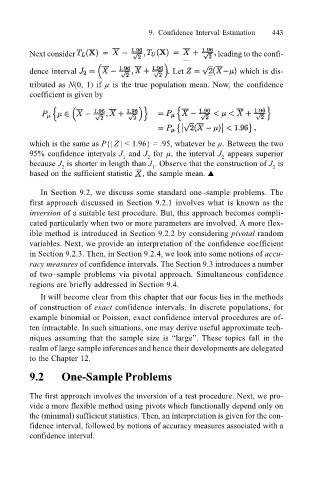
Next consider leading to the confi-
dence interval . Let which is dis-
tributed as N(0, 1) if µ is the true population mean. Now, the confidence
coefficient is given by
which is the same as P{| Z | < 1.96} = .95, whatever be µ. Between the two
95% confidence intervals J and J for µ, the interval J appears superior
2
2
1
because J is shorter in length than J . Observe that the construction of J is
2
2
1
based on the sufficient statistic , the sample mean. !
In Section 9.2, we discuss some standard onesample problems. The
first approach discussed in Section 9.2.1 involves what is known as the
inversion of a suitable test procedure. But, this approach becomes compli-
cated particularly when two or more parameters are involved. A more flex-
ible method is introduced in Section 9.2.2 by considering pivotal random
variables. Next, we provide an interpretation of the confidence coefficient
in Section 9.2.3. Then, in Section 9.2.4, we look into some notions of accu-
racy measures of confidence intervals. The Section 9.3 introduces a number
of twosample problems via pivotal approach. Simultaneous confidence
regions are briefly addressed in Section 9.4.
It will become clear from this chapter that our focus lies in the methods
of construction of exact confidence intervals. In discrete populations, for
example binomial or Poisson, exact confidence interval procedures are of-
ten intractable. In such situations, one may derive useful approximate tech-
niques assuming that the sample size is large. These topics fall in the
realm of large sample inferences and hence their developments are delegated
to the Chapter 12.
9.2 One-Sample Problems
The first approach involves the inversion of a test procedure. Next, we pro-
vide a more flexible method using pivots which functionally depend only on
the (minimal) sufficient statistics. Then, an interpretation is given for the con-
fidence interval, followed by notions of accuracy measures associated with a
confidence interval.

