


Page 513 - Probability and Statistical Inference
P. 513
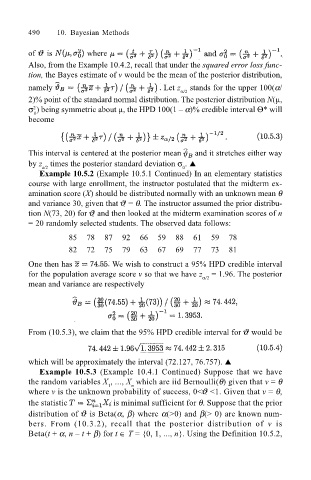
490 10. Bayesian Methods
of is where
Also, from the Example 10.4.2, recall that under the squared error loss func-
tion, the Bayes estimate of v would be the mean of the posterior distribution,
namely Let z stands for the upper 100(α/
α/2
2)% point of the standard normal distribution. The posterior distribution N(µ,
σ ) being symmetric about µ, the HPD 100(1 α)% credible interval Θ* will
2
0
become
This interval is centered at the posterior mean and it stretches either way
by z times the posterior standard deviation σ . !
a/2
0
Example 10.5.2 (Example 10.5.1 Continued) In an elementary statistics
course with large enrollment, the instructor postulated that the midterm ex-
amination score (X) should be distributed normally with an unknown mean θ
and variance 30, given that = θ. The instructor assumed the prior distribu-
tion N(73, 20) for and then looked at the midterm examination scores of n
= 20 randomly selected students. The observed data follows:
85 78 87 92 66 59 88 61 59 78
82 72 75 79 63 67 69 77 73 81
One then has We wish to construct a 95% HPD credible interval
for the population average score v so that we have z = 1.96. The posterior
α/2
mean and variance are respectively
From (10.5.3), we claim that the 95% HPD credible interval for would be
which will be approximately the interval (72.127, 76.757). !
Example 10.5.3 (Example 10.4.1 Continued) Suppose that we have
the random variables X , ..., X which are iid Bernoulli(θ) given that v = θ
1 n
where v is the unknown probability of success, 0< <1. Given that v = θ,
the statistic is minimal sufficient for θ. Suppose that the prior
distribution of is Beta(α, β) where α(>0) and β(> 0) are known num-
bers. From (10.3.2), recall that the posterior distribution of v is
Beta(t + α, n t + β) for t ∈ T = {0, 1, ..., n}. Using the Definition 10.5.2,

