


Page 523 - Probability and Statistical Inference
P. 523
500 10. Bayesian Methods
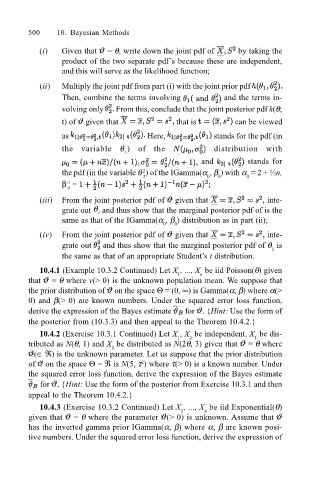
(i) Given that = θ, write down the joint pdf of by taking the
product of the two separate pdfs because these are independent,
and this will serve as the likelihood function;
(ii) Multiply the joint pdf from part (i) with the joint prior pdf
Then, combine the terms involving and the terms in-
volving only From this, conclude that the joint posterior pdf k(θ;
t) of given that that is can be viewed
as Here, stands for the pdf (in
the variable θ ) of the distribution with
1
and stands for
the pdf (in the variable θ ) of the IGamma(α , β ) with α = 2 + ½n,
2
2 0 0 0
β =
-1
0
(iii) From the joint posterior pdf of given that inte-
grate out θ and thus show that the marginal posterior pdf of is the
1
same as that of the IGamma(α , β ) distribution as in part (ii);
0 0
(iv) From the joint posterior pdf of given that inte-
grate out and thus show that the marginal posterior pdf of θ is
1
the same as that of an appropriate Students t distribution.
10.4.1 (Example 10.3.2 Continued) Let X , ..., X be iid Poisson(θ) given
1
n
that = θ where v(> 0) is the unknown population mean. We suppose that
the prior distribution of on the space Θ = (0, ∞) is Gamma(α, β) where α(>
0) and β(> 0) are known numbers. Under the squared error loss function,
derive the expression of the Bayes estimate for . {Hint: Use the form of
the posterior from (10.3.3) and then appeal to the Theorem 10.4.2.}
10.4.2 (Exercise 10.3.1 Continued) Let X , X be independent, X be dis-
2
1
1
tributed as N(θ, 1) and X be distributed as N(2θ, 3) given that = θ where
2
(∈ ℜ) is the unknown parameter. Let us suppose that the prior distribution
of on the space Θ = ℜ is N(5, τ ) where τ(> 0) is a known number. Under
2
the squared error loss function, derive the expression of the Bayes estimate
for . {Hint: Use the form of the posterior from Exercise 10.3.1 and then
appeal to the Theorem 10.4.2.}
10.4.3 (Exercise 10.3.2 Continued) Let X , ..., X be iid Exponential(θ)
n
1
given that = θ where the parameter (> 0) is unknown. Assume that
has the inverted gamma prior IGamma(α, β) where α, β are known posi-
tive numbers. Under the squared error loss function, derive the expression of

