


Page 173 - Purchasing Power Black Kids and American Consumer Culture
P. 173
158  .  Ethnically Correct  Dolls


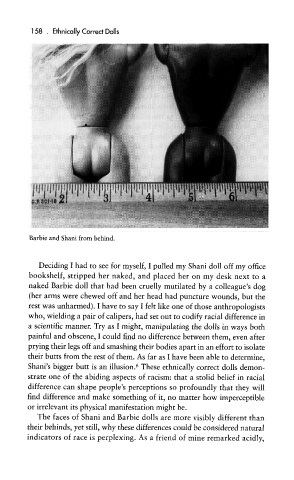
        Barbie and  Shani from  behind.


          Deciding I had  to  see for  myself,  I pulled my Shani doll off my  office
       bookshelf,  stripped  her  naked,  and  placed  her  on  my desk  next  to  a
       naked  Barbie doll  that had  been cruelly mutilated  by a colleague's  dog
       (her arms were chewed  off and  her head  had puncture wounds,  but the
       rest was unharmed). I have to  say I felt like one of those  anthropologists
       who, wielding a pair of calipers, had  set out to codify  racial difference  in
       a  scientific  manner.  Try as I might, manipulating  the dolls in ways  both
       painful  and  obscene,  I could find no  difference  between them, even after
       prying their legs off and smashing their bodies apart in an effort  to  isolate
       their butts from  the rest of them. As far as I have been able to determine,
       Shani's  bigger butt  is an  illusion. 6  These  ethnically correct  dolls demon-
       strate  one  of the  abiding aspects  of racism: that  a  stolid  belief  in racial
       difference  can  shape people's  perceptions  so profoundly that  they will
       find difference  and  make  something of it, no  matter  how imperceptible
       or irrelevant its physical manifestation might be.
          The  faces  of Shani and  Barbie dolls are more  visibly different  than
       their behinds,  yet still, why these differences could  be considered  natural
       indicators  of race  is perplexing.  As a friend  of mine remarked acidly,

