


Page 171 - Purchasing Power Black Kids and American Consumer Culture
P. 171
156  .  Ethnically  Correct Dolls


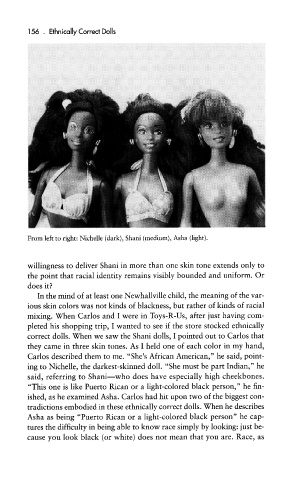
       From  left to right: Nichelle (dark), Shani (medium), Asha (light).


       willingness to deliver Shani in more than  one skin tone extends only to
       the point that racial identity remains visibly bounded and  uniform. Or
       does it?
         In the mind of at least one Newhallville child, the meaning of the var-
       ious skin colors was not kinds of blackness, but rather  of kinds of racial
       mixing. When  Carlos  and  I were in Toys-R-Us, after  just having com-
       pleted  his shopping trip, I wanted  to  see if the  store  stocked ethnically
       correct dolls. When we saw the Shani dolls, I pointed  out to  Carlos that
       they came in three skin tones. As I held one  of each color  in my hand,
       Carlos described them to me.  "She's African  American," he said, point-
       ing to Nichelle, the darkest-skinned doll.  "She must be part Indian," he
       said, referring  to  Shani—who  does  have especially high cheekbones.
       "This one  is like Puerto  Rican or  a light-colored  black person,"  he fin-
       ished, as he examined Asha. Carlos had hit upon two  of the biggest con-
       tradictions embodied in these ethnically correct dolls. When he describes
       Asha  as being "Puerto  Rican or  a light-colored  black person"  he cap-
       tures the difficulty  in being able to know race simply by looking: just be-
       cause you  look  black  (or white) does not  mean that you  are. Race, as

