


Page 181 - Purchasing Power Black Kids and American Consumer Culture
P. 181
166  .  Ethnically Correct  Dolls


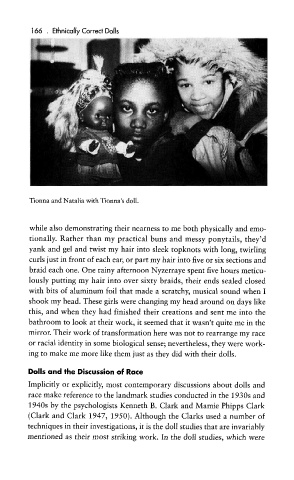
        Tionna and Natalia with Tionna's  doll.


        while also demonstrating  their nearness to me both  physically and  emo-
        tionally.  Rather  than  my practical  buns  and  messy  ponytails,  they'd
        yank  and gel and  twist  my hair  into  sleek topknots with  long,  twirling
        curls just in front  of each ear, or part my hair into five or six sections  and
        braid each one.  One rainy afternoon Nyzerraye spent five hours meticu-
       lously putting  my hair  into  over  sixty  braids,  their  ends  sealed  closed
       with  bits  of aluminum foil  that made  a  scratchy,  musical sound  when  I
       shook  my head.  These girls were changing my head  around  on days like
       this, and  when  they  had  finished  their  creations  and  sent  me into  the
       bathroom  to look  at their work,  it seemed that  it wasn't quite me in the
       mirror. Their work  of transformation  here was not to rearrange my race
       or racial identity in some biological sense; nevertheless, they were work-
       ing to make me more  like them just as they did with their dolls.

       Dolls and  the  Discussion of  Race
       Implicitly  or  explicitly, most  contemporary  discussions  about  dolls  and
       race make reference to the landmark  studies  conducted in the 1930s and
       1940s  by the  psychologists Kenneth B. Clark  and  Mamie  Phipps  Clark
       (Clark  and  Clark  1947,  1950).  Although the  Clarks  used a number of
       techniques in their investigations, it is the doll studies that are invariably
       mentioned  as their most striking work. In the  doll studies, which  were

