


Page 310 - Reservoir Formation Damage
P. 310
290   Reservoir Formation Damage

                Radial  Filtration  Applications

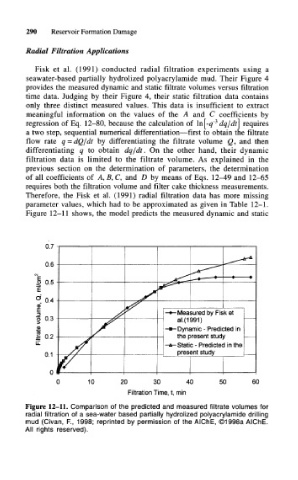
                  Fisk  et  al.  (1991)  conducted  radial  filtration  experiments  using  a
                seawater-based  partially hydrolized  polyacrylamide  mud. Their  Figure  4
                provides  the  measured dynamic  and  static filtrate  volumes versus filtration
                time  data.  Judging by  their  Figure  4,  their  static  filtration data  contains
                only  three  distinct  measured  values.  This  data  is  insufficient  to  extract
                meaningful  information  on  the  values  of  the  A  and  C  coefficients  by
                                                                  3
                regression  of  Eq.  12-80, because  the  calculation of  In [-q~  dq/dt\  requires
                a  two  step,  sequential numerical differentiation—first  to obtain  the  filtrate
                flow  rate  q = dQ/dt  by  differentiating the  filtrate  volume  Q,  and  then
                differentiating  q  to  obtain  dq/dt.  On  the  other  hand,  their  dynamic
                filtration  data  is  limited  to  the  filtrate  volume.  As  explained  in  the
                previous  section  on  the  determination  of  parameters,  the  determination
                of  all  coefficients of  A, B, C,  and  D  by  means  of  Eqs.  12-49  and  12-65
                requires both the filtration volume and filter  cake  thickness measurements.
                Therefore,  the  Fisk  et  al.  (1991)  radial  filtration  data  has  more  missing
                parameter  values, which had  to  be  approximated  as given in  Table  12-1.
                Figure  12-11  shows, the  model  predicts  the measured  dynamic and static


                                10       20       30      40       50       60
                                           Filtration Time, t, min
               Figure  12-11. Comparison  of the  predicted  and  measured filtrate volumes for
               radial filtration  of a sea-water  based  partially  hydrolized polyacrylamide drilling
               mud  (Civan,  F., 1998; reprinted  by  permission  of  the AlChE, ©1998a AlChE.
               All  rights  reserved).

