


Page 306 - Reservoir Formation Damage
P. 306
286    Reservoir Formation Damage

                     0.002


                jg  0.0015
                c
                                      y = 0.0229X - 0.0003
                                          2
                                         R  = 0.9873
                co  o  0.001
                O  *7
                C  T3
                O
                    0.0005                                *  Predicted
                                                         —   Linear (Predicted)


                                    0.02      0.04      0.06       0.08       0.1
                                           Filtrate Flow Rate, q, ml/min
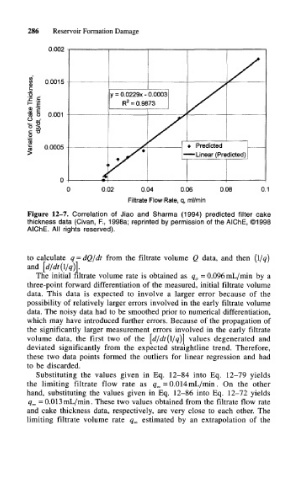
                Figure  12-7.  Correlation  of  Jiao  and  Sharma  (1994)  predicted  filter  cake
                thickness  data  (Civan,  R,  1998a;  reprinted  by permission  of the AlChE, ©1998
                AlChE.  All  rights  reserved).


                to  calculate  q = dQ/dt  from  the  filtrate  volume  Q  data,  and  then  (\/q)
                and  [d/dt(l/q)].
                  The  initial  filtrate  volume rate  is  obtained  as  q 0 = 0.096 mL/min  by  a
                three-point  forward differentiation of the  measured,  initial filtrate volume
                data.  This  data  is  expected  to  involve  a  larger  error  because  of  the
                possibility  of relatively  larger errors  involved  in the  early  filtrate  volume
                data. The noisy data  had to be  smoothed  prior  to numerical differentiation,
                which  may have introduced further  errors.  Because  of the  propagation of
                the  significantly larger  measurement  errors  involved  in  the  early  filtrate
                volume  data,  the  first  two  of  the  [d/dt  (l/q)]  values  degenerated  and
                deviated  significantly  from  the  expected  straightline  trend.  Therefore,
                these  two  data  points  formed  the  outliers  for  linear  regression  and  had
                to  be  discarded.
                  Substituting  the  values  given  in  Eq.  12-84  into  Eq.  12-79  yields
                the  limiting  filtrate  flow  rate  as  q x =0.014mL/min.  On  the  other
                hand,  substituting the  values  given  in  Eq.  12-86  into  Eq.  12-72  yields
                q x = 0.013mL/min. These two values  obtained  from the filtrate  flow rate
                and  cake  thickness  data,  respectively,  are  very  close  to  each  other.  The
                limiting  filtrate  volume  rate  q x  estimated  by  an  extrapolation  of  the

