


Page 304 - Reservoir Formation Damage
P. 304
284   Reservoir Formation Damage

                Applications

                  The  numerical  solutions  of the present  models  require  the information
                on the characteristics  of the  slurries,  particulates,  carrier  fluids,  filters  and
                filter  cakes,  the  actual conditions  of  the  tests conducted,  and the  measure-
                ments  of  all  the  system  parameters  and  variables.  The  reported  studies
                of  the  slurry  filtration  have  measured  only  a  few  parameters  and  the
                filtrate  volumes  or  rates  and  do  not  offer  a  complete  set  of  suitable  data
                that  is  needed  for  full  scale  experimental  verification  of  the  present
                models.  Civan  (1998a)  used the Willis  et  al.  (1983)  and Jiao  and  Sharma
                (1994)  data  for  linear  filtration, and  the  Fisk  et  al.  (1991)  data  for  radial
                filtration,  because  these  data  provide  more  information  than  the  other
                reported  studies. The  data  is presented  in Table  12-1 in consistent  Darcy
                units,  which  are  more  convenient  for  flow  through  porous  media.

                Linear  Filtration  Applications

                  Jiao  and  Sharma  (1994)  carried  out  linear  filtration experiments using
                concentrated  bentonite  suspensions.  They  only  measured  the  filtrate
                volume  and  predicted  the  filter  cake  thickness  using  a  simple  algebraic
                model.  These  data  are  given  in  their  Figures  3  and  10, respectively.  In
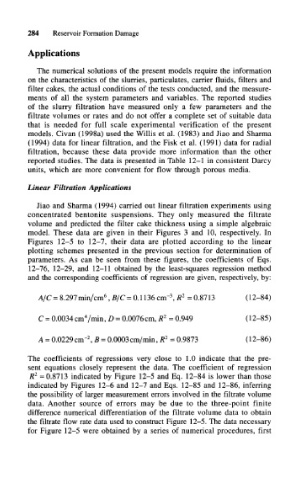
                Figures  12-5  to  12-7,  their  data  are  plotted  according  to  the  linear
                plotting  schemes  presented  in  the  previous  section  for  determination  of
                parameters.  As  can  be  seen  from  these  figures,  the  coefficients  of Eqs.
                12-76,  12-29,  and  12-11  obtained  by  the  least-squares  regression  method
                and  the  corresponding  coefficients  of  regression  are  given,  respectively,  by:


                                    6                 3  2
                  A/C = 8.297min/cm , B/C = 0.1136 cm- , R  = 0.8713      (12-84)
                               4
                   C = 0.0034cm /min, D = 0.0076cm,  R 2  = 0.949         (12-85)
                                2                   2
                  A = 0.0229 cnT , B = 0.0003 cm/min, R  = 0.9873         (12-86)

                The  coefficients  of  regressions  very  close  to  1.0  indicate  that  the pre-
                sent  equations  closely  represent  the  data.  The  coefficient  of  regression
                 2
                R  =0.8713  indicated by Figure  12-5 and Eq.  12-84 is lower than  those
                indicated  by Figures  12-6 and  12-7 and Eqs.  12-85 and  12-86, inferring
                the possibility  of larger measurement  errors involved  in the filtrate  volume
                data.  Another  source  of  errors  may  be  due  to  the  three-point  finite
                difference  numerical  differentiation of  the  filtrate  volume  data  to  obtain
                the filtrate flow rate data used to construct Figure  12-5. The data  necessary
                for  Figure  12-5 were  obtained  by  a  series  of  numerical  procedures,  first

