


Page 303 - Reservoir Formation Damage
P. 303
Cake Filtration: Mechanism, Parameters and Modeling  283

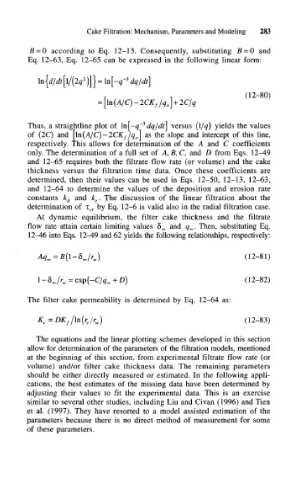
              5 = 0  according  to  Eq.  12-13.  Consequently,  substituting  B = 0  and
             Eq.  12-63,  Eq.  12-65 can  be  expressed  in  the  following linear  form:


                                                                        (12-80)
                                =   [\n(A/C)-2CK f/q 0]

                                            3
             Thus,  a  straightline  plot  of  ln[-g  dq/dt\  versus  (l/q]  yields  the  values
             of  (2C) and  [ln(A/C)-2C£y/<7 0]  as  the  slope  and  intercept  of  this  line,
             respectively.  This  allows  for  determination  of  the  A  and  C  coefficients
             only.  The  determination  of  a  full  set  of  A, B, C,  and  D  from  Eqs.  12-49
             and  12-65 requires  both  the  filtrate  flow  rate  (or  volume)  and  the  cake
             thickness  versus  the  filtration  time  data.  Once  these  coefficients  are
             determined,  then  their  values  can be  used  in Eqs. 12-50,  12-13,  12-63,
             and  12-64 to  determine  the  values  of  the  deposition  and  erosion  rate
             constants  k d  and  k e.  The  discussion  of  the  linear  filtration  about  the
             determination  of  i cr  by Eq. 12-6 is valid  also  in the radial  filtration  case.
                At  dynamic  equilibrium,  the  filter  cake  thickness  and  the  filtrate
             flow  rate  attain  certain  limiting  values  8^  and  q x. Then,  substituting Eq.
              12-46 into Eqs. 12-49 and 62 yields the following relationships,  respectively:


                Aq_=B(l-SJr w)                                         (12-81)

                                    + D)                               (12-82)


             The  filter  cake  permeability  is  determined  by  Eq.  12-64 as:

                   = DK f/\n(r e/r w)                                  (12-83)
                K c
                The equations  and the  linear  plotting  schemes  developed  in this  section
             allow  for  determination  of the  parameters  of  the  filtration  models,  mentioned
             at  the  beginning  of  this  section,  from  experimental  filtrate  flow  rate  (or
             volume)  and/or  filter  cake  thickness  data.  The  remaining  parameters
             should  be  either  directly  measured  or  estimated.  In  the  following  appli-
             cations,  the  best  estimates  of  the  missing  data  have  been  determined  by
             adjusting  their  values  to  fit  the  experimental  data.  This  is  an  exercise
             similar  to  several  other  studies, including Liu  and Civan  (1996)  and  Tien
             et  al.  (1997).  They  have  resorted  to  a  model  assisted  estimation  of  the
             parameters  because  there  is  no  direct  method  of  measurement  for  some
             of  these  parameters.

