


Page 299 - Reservoir Formation Damage
P. 299
Cake Filtration: Mechanism, Parameters  and Modeling  279

                The  wall  shear-stress  is  calculated  by  Eq.  12-47 for  the  varying  cake
              radius,  r c=r c(t}.  The  filter  cake  thickness  is  calculated  by  means  of
              Eqs.  12-46  and  62.  Equations  12-65 and  66  can  be  solved  numerically
              using  an  appropriate  method  such  as  the  Runge-Kutta  method. How-
              ever,  for  thin  cakes,  it  is  reasonable  to  assume  that  the  wall-shear  stress
              is  approximately  constant,  because  r c=r w.  Then,  Eq.  12-65 can  be
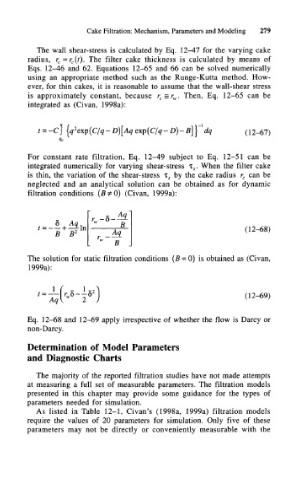
              integrated  as  (Civan,  1998a):


                      q

              For  constant  rate  filtration,  Eq.  12-49 subject  to  Eq.  12-51 can  be
              integrated  numerically  for varying  shear-stress  i s. When  the filter  cake
              is  thin,  the  variation  of  the  shear-stress  i s  by  the  cake  radius  r c  can be
              neglected  and  an  analytical  solution  can  be  obtained  as  for  dynamic
              filtration  conditions  (fi*0)  (Civan,  1999a):


                     8   Aq.
                t =    + —f-ln                                          (12-68)
                          2
                     B   B
                                T  -
                                     B
              The  solution  for  static  filtration conditions  (B = 0)  is obtained  as (Civan,
              1999a):


                         s
                             1*2 2
                t =     r w 5--8
                        w                                               (12-69)
                            2
              Eq.  12-68 and  12-69 apply  irrespective  of whether  the  flow  is  Darcy  or
              non-Darcy.


              Determination    of  Model  Parameters
              and  Diagnostic  Charts

                The  majority  of the  reported  filtration  studies have  not  made  attempts
              at  measuring  a  full  set  of  measurable  parameters.  The  filtration  models
              presented  in  this  chapter  may  provide  some  guidance  for  the  types  of
              parameters  needed  for  simulation.
                As  listed  in  Table  12-1,  Civan's  (1998a,  1999a)  filtration  models
              require  the  values  of  20  parameters  for  simulation.  Only  five  of  these
              parameters  may  not  be  directly  or  conveniently  measurable  with  the

