


Page 302 - Reservoir Formation Damage
P. 302
282    Reservoir Formation Damage

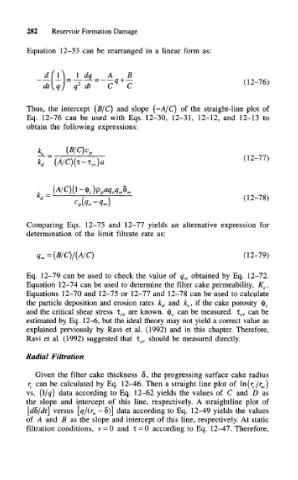
                Equation  12-33 can  be  rearranged  in  a  linear  form  as:


                     d(\\    1 dq     A    B
                                         n H
                        —  = i =        q +                               (12-76)
                    dt(q        dt
                Thus,  the  intercept  (B/C)  and  slope  (-A/C)  of  the  straight-line  plot  of
                Eq.  12-76 can  be  used  with  Eqs. 12-30,  12-31,  12-12,  and  12-13 to
                obtain  the  following  expressions:

                           (B/C),
                                                                          (12-77)
                        (A/C)(t-T c>
                   k d

                   ,  _
                    d~                                                    (12-78)


                Comparing  Eqs. 12-75 and  12-77 yields  an  alternative  expression  for
                determination  of  the  limit  filtrate  rate  as:


                   q x=(B/C)/(A/C)                                        (12-79)

                Eq.  12-79 can be used  to  check  the value of  q x  obtained  by Eq.  12-72.
                Equation  12-74 can be used to determine  the filter  cake permeability,  K c.
                Equations  12-70 and  12-75 or  12-77 and  12-78 can be used to calculate
                the  particle  deposition  and  erosion  rates  k d  and  k e, if  the  cake  porosity  <J) C
                and  the critical  shear  stress  i cr  are known.  ty c  can be measured.  i cr can be
                estimated by Eq.  12-6, but the ideal  theory may not yield a correct  value as
                explained  previously  by  Ravi  et  al.  (1992)  and  in  this  chapter.  Therefore,
                Ravi  et  al.  (1992)  suggested  that  i cr  should be  measured  directly.

                Radial  Filtration

                  Given  the  filter  cake  thickness  8,  the progressing  surface  cake  radius
                   can  be  calculated  by  Eq.  12-46.  Then  a  straight  line plot  of  ln(r c /r w )
                r c
                vs.  (l/q)  data  according  to  Eq.  12-62 yields  the  values  of  C  and  D  as
                the  slope  and  intercept  of  this  line,  respectively.  A  straightline  plot  of
                [d8/df]  versus  \q/(r w -8)]  data  according  to Eq.  12-49 yields the  values
                of  A  and  B  as the  slope  and intercept  of  this  line,  respectively. At  static
                filtration  conditions,  v = 0  and  T = 0  according  to  Eq.  12-47.  Therefore,

