


Page 344 - Reservoir Formation Damage
P. 344
324   Reservoir Formation Damage

                temperature  during the  production  of  reservoir  fluids.  Scaling  associated
                with  the  improved  recovery  processes,  such  as  water,  carbonated  water,
                alkaline  water,  and  carbon  dioxide  injection,  may  be  caused  by  mixing
                incompatible  fluids  and/or  pressure  and  temperature  variations.
                  The  scale  formation  mechanisms  can  be  classified  as:  (1)  natural
                scaling  and  (2) induced  scaling  (Amaefule  et  al.,  1988).  These  mechanisms
                can  be best  explained  by  means  of  scale  precipitation  charts,  such as  those
                given  by  Shaughnessy  and  Kline  (1982,  1983),  who  developed  practical
                                                                          +2
                charts  depicting  the relationships  between  dissolved  calcium  (Ca ) and
               bicarbonate  (HCO^  ions,  calcium  carbonate  (CaCO 3)  precipitate,  CO 2
                partial  and  total  pressures,  and  temperature,  based  on  the  equilibrium
                relationship  for  the  calcium  carbonate  scale  formation  by  the  reaction

                     +2
                  Ca              CaCO 3(s)  + CO 2(g}  + H 2O             (13-1)

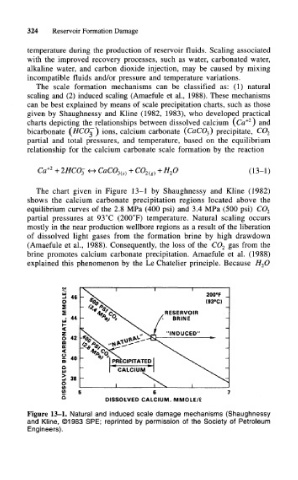
                  The  chart  given  in  Figure  13-1  by  Shaughnessy  and  Kline  (1982)
                shows  the  calcium  carbonate  precipitation  regions  located  above  the
               equilibrium  curves  of  the  2.8  MPa  (400 psi) and  3.4 MPa  (500 psi)  CO 2
               partial  pressures  at  93°C  (200°F)  temperature.  Natural  scaling  occurs
               mostly  in the near production  wellbore  regions  as  a result of the  liberation
                of  dissolved  light  gases  from  the  formation  brine  by  high  drawdown
                (Amaefule  et  al.,  1988).  Consequently,  the  loss  of  the  CO 2  gas  from  the
               brine  promotes  calcium  carbonate  precipitation.  Amaefule  et  al.  (1988)
                explained  this  phenomenon  by  the  Le Chatelier  principle.  Because  H 2O


                                                               200«F
                           46
                                                                  C)

                           44

                           42

                         ~  40
                         Q
                         01
                         3  38
                         O
                         V)
                         <2  s
                                    DISSOLVED  CALCIUM, MMOLE/B
               Figure  13-1. Natural  and  induced  scale  damage  mechanisms  (Shaughnessy
                and  Kline, ©1983  SPE; reprinted  by  permission  of  the  Society  of  Petroleum
                Engineers).

