


Page 349 - Reservoir Formation Damage
P. 349
Inorganic Scaling and Geochemical Formation Damage  329

             equilibrium  assumption  is  usually  considered  reasonable  (Walsh  et  al.,
              1982,  Lichtner,  1992; Liu  et  al.,  1997; Liu  and  Ortaleva,  1996,  1996).
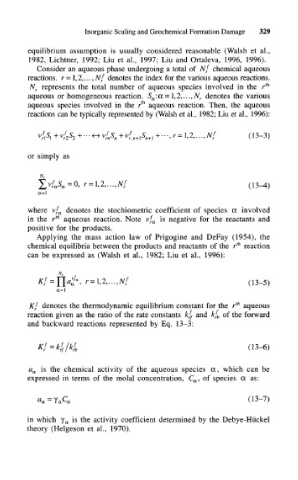
                Consider  an  aqueous phase  undergoing a total  of  Nf  chemical  aqueous
             reactions,  r = 1,2,...,Nf  denotes the index for the various  aqueous  reactions.
                 represents  the  total  number  of  aqueous  species  involved  in  the  r th
              N r
             aqueous  or  homogeneous  reaction.  S a:a. = l,2,...,N r  denotes  the  various
                                            th
             aqueous  species  involved  in  the  r  aqueous  reaction.  Then,  the  aqueous
             reactions  can be typically  represented  by  (Walsh et al.,  1982; Liu et al.,  1996):

                                                                        (13-3)


             or  simply  as


                                                                        (13-4)


             where  v/ a  denotes  the  stochiometric  coefficient  of  species  a  involved
             in  the  r th  aqueous  reaction.  Note  v/ a  is  negative  for  the  reactants  and
             positive  for  the  products.
                Applying  the  mass  action  law  of  Prigogine  and  DeFay  (1954),  the
             chemical  equilibria  between  the products  and reactants  of the  r th  reaction
             can  be  expressed  as  (Walsh  et  al.,  1982; Liu  et  al.,  1996):


                 f       ra             f
                                      N
                             r = 12
                     11 "a
                K r  =Y\a  ' '  i,^,...,lV r                            (13-5)
                     a=l
              K*  denotes  the thermodynamic  equilibrium  constant  for the  r th  aqueous
             reaction  given  as  the  ratio  of  the  rate  constants  kjj  and  k, b  of  the  forward
             and  backward  reactions  represented  by  Eq.  13-3:


                                                                        (13-6)

                 is  the  chemical  activity  of  the  aqueous  species  a,  which  can  be
              fl a
             expressed  in  terms  of  the  molal  concentration,  C a,  of  species  a  as:

                a                                                       (13-7)
                  ~

             in  which  y a  is  the  activity  coefficient  determined  by  the  Debye-Huckel
             theory  (Helgeson  et  al.,  1970).

