


Page 350 - Reservoir Formation Damage
P. 350
330   Reservoir Formation Damage

                Mineral   Reactions

                  The  reactions  of  the  aqueous  phase  species  with  the  solid  mineral
                matter  of the  porous  matrix  are referred  to  as the mineral  reactions.  Most
                mineral  reactions  are  typically  hydrolysis  reactions.  The  interactions  of
                minerals  and  aqueous  species  are  generally  slow  relative  to  the aqueous
                phase  reactions  (Lichtner,  1992). Their  reaction  kinetics  are controlled  by
                the  external  mineral  surface  area  contacting  the  aqueous  phase.  The
                mineral  surface area  is determined  by the  sizes  of the  grains  of the porous
                formation.  The  rates  of  mineral  reactions  are  gradual  and, therefore,
                require  kinetic  descriptions  with  finite  reaction  rate  constants.
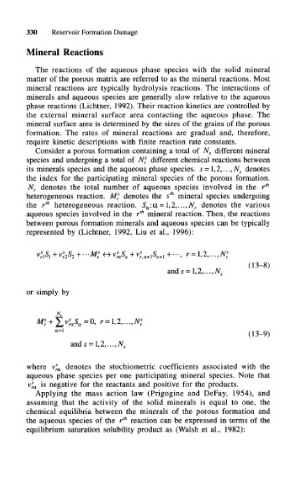
                  Consider  a porous formation  containing  a total  of  A^  different  mineral
                species  and  undergoing a total of  Nf  different  chemical reactions between
                its  minerals  species  and the  aqueous phase  species.  s = \,2,...,N s  denotes
                the  index  for  the  participating  mineral  species  of  the  porous  formation.
                   denotes  the  total  number  of  aqueous  species  involved  in  the  r th
                N r
                heterogeneous  reaction.  M r s  denotes  the  s th  mineral  species  undergoing
                the  r th  heterogeneous  reaction.  S a:ai = l,2,...,N r  denotes  the  various
                aqueous  species  involved in the  r th  mineral  reaction.  Then,  the reactions
                between  porous  formation minerals  and  aqueous  species  can be  typically
                represented  by  (Lichtner,  1992, Liu  et  al.,  1996):


                                                            = l,2,...,N* r
                                                                           (13-8)


                or  simply  by


                       a=l
                                                                           (13-9)


                       s
                where  v m  denotes  the  stochiometric  coefficients  associated  with  the
                aqueous  phase  species  per  one  participating  mineral  species.  Note  that
                 s
                v m  is  negative  for  the  reactants  and  positive  for  the  products.
                  Applying  the  mass  action  law  (Prigogine  and  DeFay,  1954),  and
                assuming  that  the  activity  of  the  solid  minerals  is  equal  to  one, the
                chemical  equilibria  between  the  minerals  of  the  porous  formation  and
                the  aqueous  species  of  the  r th  reaction  can  be  expressed  in  terms  of  the
                equilibrium  saturation  solubility  product  as  (Walsh  et  al.,  1982):

