


Page 353 - Reservoir Formation Damage
P. 353
Inorganic Scaling and Geochemical Formation Damage  333


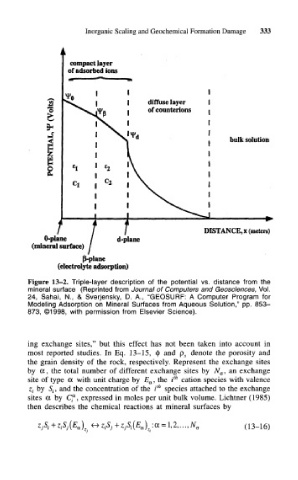
                         compact layer
                        of adsorbed ions


                                                                   bulk solution


                                                             DISTANCED (meters)
                  0-plane
              (mineral surface)
                            p*-plane
                     (electrolyte adsorption)

             Figure  13-2.  Triple-layer  description  of  the  potential  vs.  distance  from  the
             mineral  surface  (Reprinted from Journal  of Computers and  Geosciences, Vol.
             24,  Sahai,  N.,  &  Sverjensky,  D.  A.,  "GEOSURF:  A  Computer  Program  for
             Modeling Adsorption  on  Mineral  Surfaces  from Aqueous  Solution,"  pp.  853-
             873,  ©1998,  with  permission  from  Elsevier  Science).


             ing  exchange  sites,"  but  this  effect  has  not  been  taken  into  account  in
             most  reported  studies.  In  Eq.  13-15,  <j)  and  p^  denote  the  porosity  and
             the  grain  density  of  the  rock,  respectively.  Represent  the  exchange  sites
             by  a,  the total  number  of different  exchange  sites  by  N a,  an  exchange
             site  of type  ot  with unit charge  by  E a, the  i' h  cation  species  with  valence
              Zi  by  S f,  and  the  concentration  of  the  i th  species  attached  to  the  exchange
             sites  a  by  C™,  expressed  in moles  per unit bulk  volume. Lichtner  (1985)
             then  describes  the  chemical  reactions  at  mineral  surfaces  by


                                                                       (13-16)

