


Page 354 - Reservoir Formation Damage
P. 354
334   Reservoir Formation Damage

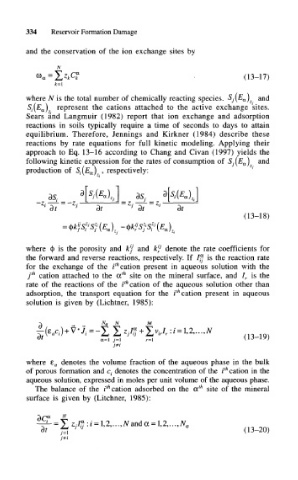
                and  the  conservation  of  the  ion  exchange  sites  by


                  «„ =                                                    (13-17)
                       jt=i

                where N is the  total  number of chemically  reacting  species.  ^ ;(^a) z  and
                Sf(E a]  represent  the  cations  attached  to  the  active  exchange  sites.
                Sears  and  Langmuir  (1982)  report  that  ion  exchange  and  adsorption
                reactions  in  soils  typically  require  a  time  of  seconds  to  days  to  attain
                equilibrium.  Therefore,  Jennings  and  Kirkner  (1984)  describe  these
                reactions  by  rate  equations  for  full  kinetic  modeling.  Applying  their
                approach  to  Eq.  13-16  according  to  Chang  and  Civan  (1997)  yields  the
                following  kinetic  expression  for  the  rates  of  consumption  of  Sj (E a )  and
                production  of  Sf(E a]  ,  respectively:                   J

                                             as,
                    iy                         „ _ --T
                     ' dt
                                                                          (13-18)


                where  (|)  is  the  porosity  and  kj  and  k' r j  denote  the  rate  coefficients  for
                the  forward  and reverse  reactions,  respectively.  If  /"  is the reaction  rate
                                       th
                for  the  exchange  of  the  i  cation  present  in  aqueous  solution  with  the
                j th  cation  attached  to  the  a th  site  on  the  mineral  surface,  and  I r  is  the
                rate  of  the  reactions  of  the  /"'cation  of  the  aqueous  solution  other  than
                adsorption,  the  transport  equation  for  the  /""cation  present  in  aqueous
                solution  is  given  by  (Lichtner,  1985):

                                                M

                                   o=l  j=l     r=l                       (13-19)


                where  e a  denotes  the  volume  fraction  of  the  aqueous  phase  in  the  bulk
                of  porous  formation and  c i  denotes  the  concentration  of  the  /"" cation  in  the
                aqueous  solution, expressed  in  moles  per  unit  volume  of the  aqueous  phase.
                  The  balance  of  the  /""cation  adsorbed  on  the  a' h  site  of  the  mineral
                surface  is  given  by  (Litchner,  1985):


                    a?                                                    (13-20)

