


Page 351 - Reservoir Formation Damage
P. 351
Inorganic Scaling and Geochemical  Formation Damage  331


                      a=l
                                                                       (13-10)
                         and s = l,2,...,N. minerals

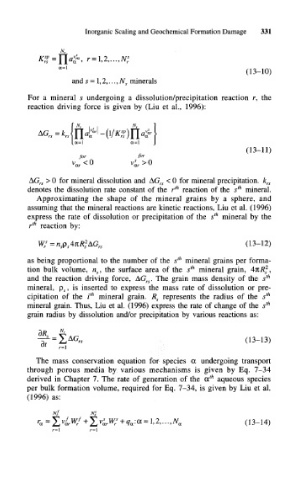
             For  a  mineral  s  undergoing  a  dissolution/precipitation  reaction  r,  the
             reaction  driving  force  is  given  by  (Liu et  al.,  1996):


                                         a=l
                                                                       (13-11)
                                           far


              AG rs  > 0  for mineral dissolution and  AG ri  < 0  for  mineral precipitation.  k rs
                                                    th               th
             denotes  the  dissolution  rate  constant  of  the  r  reaction  of  the  s  mineral.
                Approximating  the  shape  of  the  mineral  grains  by  a  sphere,  and
             assuming that the mineral  reactions  are kinetic  reactions,  Liu  et al.  (1996)
             express  the  rate  of  dissolution  or  precipitation  of  the  s th  mineral  by  the
              r th  reaction  by:

                                                                       (13-12)

             as being  proportional  to  the  number of  the  s th  mineral  grains  per  forma-
                                                                             2
             tion  bulk  volume,  n s, the  surface  area  of  the  s th  mineral  grain,  47i/?^ ,
             and  the  reaction  driving  force,  AG rj.  The  grain  mass  density  of  the  s th
             mineral,  p 5 ,  is  inserted  to  express  the  mass  rate  of  dissolution  or pre-
             cipitation  of  the  i th  mineral  grain.  R s  represents  the  radius  of  the  s th
             mineral  grain.  Thus,  Liu  et  al.  (1996)  express  the  rate  of  change  of  the  s th
             grain  radius  by  dissolution  and/or  precipitation  by  various  reactions  as:


                                                                       (13-13)
                 3r   r=l

                The  mass  conservation  equation  for  species  a  undergoing  transport
             through  porous  media  by  various  mechanisms  is  given  by  Eq.  7-34
             derived  in  Chapter  7.  The  rate  of  generation  of  the  Oi th  aqueous  species
             per  bulk  formation  volume,  required  for  Eq.  7-34,  is  given  by  Liu  et  al.
             (1996)  as:
                               s
                              N r
                         wf
                                                    N
                                                2
                                      +a
                                   W
                       / vv        YY r s  ~ ia.-* "  ^^•••i^a         (13-14)
                                          J
                                          -a = l
                                       l
                    r=l       r=\

